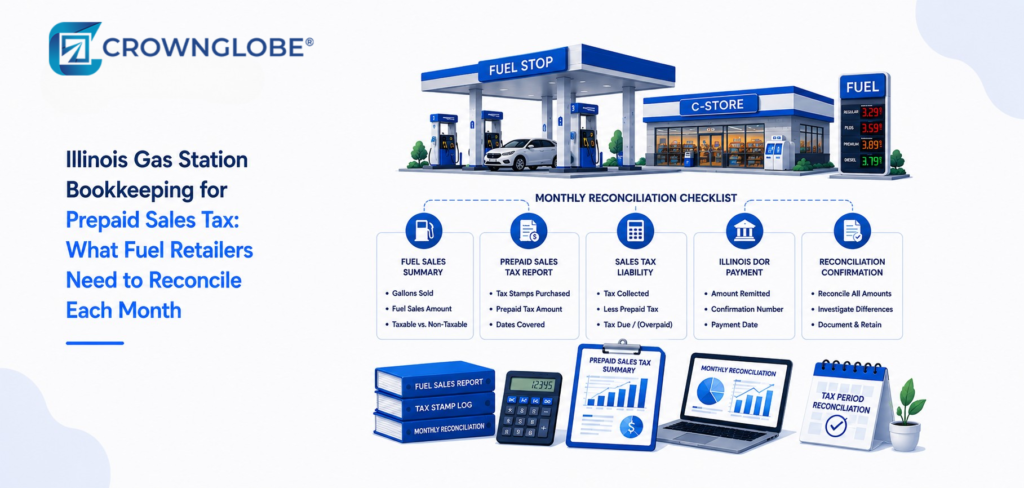
Running a gas station and convenience store in Illinois involves far more than managing fuel sales and daily store operations.
One area that often gets overlooked is prepaid sales tax reconciliation. Because certain fuel taxes are collected earlier in the distribution chain, many operators assume the accounting takes care of itself. In reality, those prepaid tax amounts still need to be tracked and reconciled accurately every month.
Many Illinois fuel retailers do an excellent job monitoring deposits, sales activity, and vendor invoices but pay less attention to prepaid tax balances sitting on the balance sheet. Over time those unreconciled amounts can create reporting errors, tax filing issues and unnecessary questions during an audit of the statements of the company.
For anyone running a convenience store and gas station doing a reconciliation is a great way to keep financial records accurate and be sure of the numbers.
Why Prepaid Sales Tax Matters in Illinois
Illinois fuel retailers operate under specific tax reporting requirements that differ from many other retail businesses.
Because certain taxes are collected earlier in the fuel supply chain, prepaid tax balances become part of the accounting process and must be recorded properly.
When bookkeeping records are not maintained carefully, prepaid tax accounts can become:
- Overstated
- Understated
- Misclassified
- Left unreconciled for extended periods
The result is often inaccurate financial reporting, unnecessary compliance risks, and additional work when preparing year-end tax filings.
This is one reason professional Gas Station and Convenience Stores Bookkeeping focuses heavily on monthly reconciliation rather than simply recording transactions.
Snippet Answer: What Is Prepaid Sales Tax for Fuel Retailers?
Prepaid sales tax is a tax amount collected earlier in the fuel distribution process and included within fuel purchases. Illinois fuel retailers should reconcile these amounts monthly to maintain accurate bookkeeping, support sales tax reporting, and ensure reliable financial statements.
The Most Common Bookkeeping Problem
Many operators accurately record fuel purchases and fuel sales but overlook the prepaid sales tax component included within supplier invoices.
This usually happens because:
- Tax details are not reviewed each month
- Vendor invoices are entered incorrectly
- Fuel inventory records are incomplete
- Sales tax accounts are never reconciled
- Monthly financial reviews are delayed
Whether you operate a single gas station and convenience store or oversee multiple locations, these small issues can gradually create larger reporting problems.
The Monthly Reconciliation Process Every Illinois Fuel Retailer Should Follow
A strong month end close starts with understanding which accounts deserve regular attention.
1. Reconcile Fuel Purchase Invoices
Start by reviewing every fuel supplier invoice received during the month.
Confirm:
- Gallons purchased
- Cost per gallon
- Taxes charged
- Prepaid sales tax amounts
- Delivery documentation
The objective is simple: your accounting records should match supplier records.
Even minor invoice discrepancies can create reporting issues later if they go unnoticed.
2. Reconcile Fuel Sales to POS Reports
Fuel sales should align with:
- POS reports
- Pump readings
- Merchant settlements
- Daily sales summaries
Any differences should be investigated promptly rather than waiting until month end or year end.
Many operators now use Finance Automation solutions to simplify this process and reduce manual errors.
For larger operations, this approach aligns closely with strategies discussed in Automated Daily Close for Convenience Stores: Reconcile POS, Fuel Readings, and Merchant Settlements Without Spreadsheets.
3. Verify Fuel Inventory Balances
Inventory discrepancies can quietly distort profitability.
Each month, compare:
- Beginning inventory
- Fuel deliveries
- Fuel sales
- Ending inventory
Unexpected variances may point to:
- Meter calibration issues
- Delivery shortages
- Data entry mistakes
- Shrinkage concerns
This process closely supports the methodology discussed in Fuel Variance Investigation Dashboard: Catch Meter Issues, Delivery Errors, and Losses Earlier.
4. Review Prepaid Sales Tax Accounts
This is often where bookkeeping accuracy begins to break down.
Every month, review:
- Opening prepaid tax balance
- Current month prepaid tax additions
- Tax applied against sales
- Ending prepaid tax balance
Prepaid tax balances should never be allowed to accumulate without explanation.
Bookkeeping and accounting teams usually check these accounts every month to make sure the financial reports are correct and ready, for an audit the Bookkeeping and accounting teams do this.
Separate Fuel Revenue from Store Revenue
Another common bookkeeping challenge is combining fuel sales and inside store sales into broad revenue accounts.
For gas stations and convenience stores, separating revenue streams provides significantly more useful business insight.
Typical revenue categories include:
- Fuel Sales
- Grocery Sales
- Beverage Sales
- Tobacco Sales
- Lottery Revenue
- Prepared Food Revenue
- Other Store Revenue
When revenue is separated properly, owners gain a clearer understanding of profitability across different parts of the business.
It also supports stronger Financial Statements Preparation, cleaner year end reporting, and more reliable decision making.
Why Monthly Reconciliation Improves Profitability
Many business owners view reconciliation as a compliance requirement.
In practice, it is also a valuable management tool.
A properly reconciled month allows you to:
- Measure fuel margins accurately
- Identify inventory losses early
- Monitor tax liabilities
- Evaluate department profitability
- Improve cash flow forecasting
For operators managing a chain of convenience stores and gas stations convenience stores and gas stations insights are really important because small reporting errors can multiply across all the convenience stores and gas stations locations.
Tax Compliance and Reporting Considerations
Illinois fuel retailers should make sure they have the records so they can report their taxes correctly throughout the year.
This includes maintaining consistency with:
- NAICS code for gas station and convenience store
- Activity code for gas station and convenience store
- Business tax filing records
- Sales tax reporting documentation
Businesses that use professional tax filling and Multistate Sales Tax Filing support often discover that monthly reconciliations make year-end compliance significantly easier.
What Lenders and Buyers Want to See
Accurate reconciliations are valuable for far more than tax reporting.
They also matter when:
- Applying for financing
- Renewing credit facilities
- Preparing for a business sale
- Going through due diligence reviews
Whether someone is evaluating a gas station and convenience store for sale in Illinois, a gas station and convenience store for sale in Pennsylvania, a gas station and convenience store for sale in Florida, a gas station and convenience store for sale in NJ, or other gas stations and convenience stores for sale across the Midwest, lenders and buyers consistently place greater trust in businesses with clean, organized financial records.
Well reconciled books demonstrate operational discipline and reduce uncertainty.
Technology Can Simplify the Process
Modern accounting technology has made month end reconciliation much more efficient than it was a decade ago.
Many fuel retailers now rely on:
- QuickBooks Bookkeeping
- Xero Bookkeeping
- Power BI Visualization
- Finance Automation
- Remote accounting support
Integrated systems reduce manual effort while improving accuracy and visibility.
Many operators also benefit from dashboards similar to those discussed in Power BI Dashboard Blueprint for Gas Stations: KPIs That Actually Move Cash Flow, helping them monitor performance throughout the month rather than waiting for month end reports.
Common Reconciliation Mistakes Fuel Retailers Should Avoid
The most common mistakes include:
- Ignoring prepaid sales tax balances
- Skipping monthly inventory reconciliations
- Failing to review fuel invoices carefully
- Combining fuel and store revenue
- Delaying month end closing procedures
- Waiting until tax season to identify problems
For anyone owning a convenience store and gas station, these issues can create avoidable compliance concerns and operational blind spots.
Building a Stronger Monthly Close Process
A reliable month end process should include:
Step 1: Reconcile fuel purchases
Step 2: Verify fuel sales
Step 3: Review inventory balances
Step 4: Reconcile prepaid sales tax accounts
Step 5: Review financial statements
Step 6: Investigate unusual variances
Step 7: Finalize monthly reports
Many operators combine Bookkeeping, Business Tax Filing, payroll processing, Financial statements preparation, and year-end finalization and annual Checkup services into a single financial management framework that provides greater visibility and control.
Conclusion
For Illinois fuel retailers, prepaid sales tax reconciliation is a part of maintaining accurate books and supporting tax compliance, for Illinois fuel retailers.
A disciplined monthly close process helps ensure that fuel purchases, inventory balances, sales tax accounts and store revenue are reported correctly every month.
For every gas station and convenience store clean reconciliations lead to financial statements fewer surprises, during tax season and better business decisions throughout the year.
Retailers who understand and reconcile their numbers are the ones who’re best positioned for long term profitability and growth of the retailers.
FAQ Section
What is prepaid sales tax for Illinois gas stations?
Prepaid sales tax is a tax amount collected earlier in the fuel distribution process that must be properly tracked and reconciled within a retailer’s accounting records.
How often should prepaid sales tax accounts be reconciled?
Monthly reconciliation is recommended because it improves financial accuracy, supports compliance, and helps identify issues before they become larger problems.
Why should fuel sales and store sales be separated?
Separate reporting provides clearer profitability analysis, stronger inventory management, and more accurate financial statements.
What accounting software works best for gas stations?
Many operators use QuickBooks Bookkeeping, Xero Bookkeeping, and integrated finance automation tools to improve reporting accuracy and visibility.
Does monthly reconciliation help during an audit?
Yes. Consistent monthly reconciliations create stronger documentation, reduce reporting errors, and help demonstrate sound financial controls during an audit.