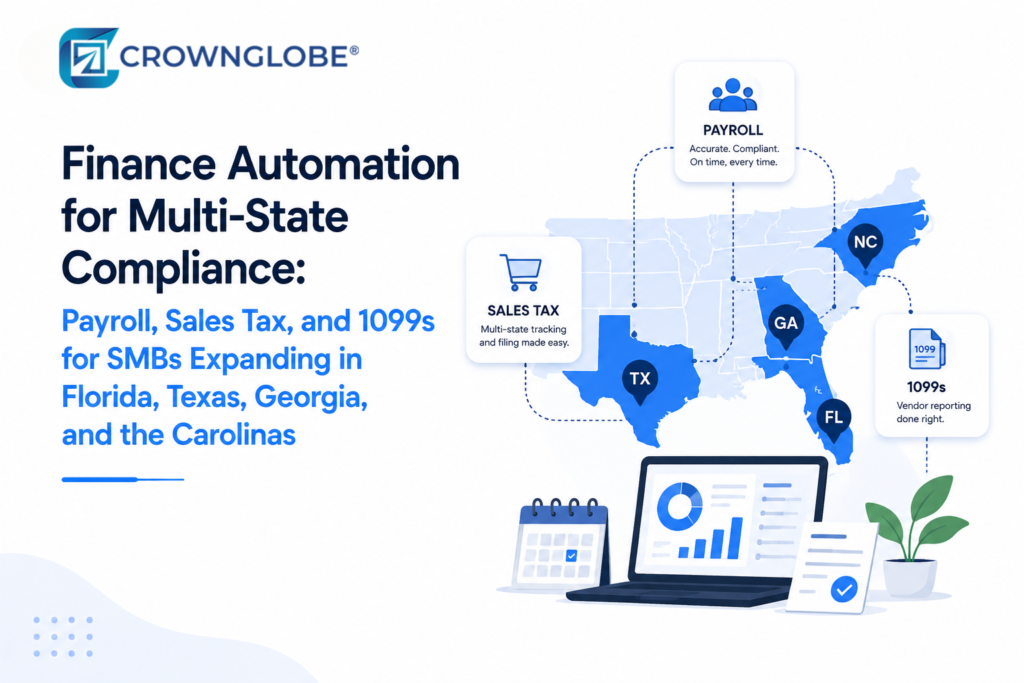
Expanding into multiple states is an exciting milestone for growing SMBs.
But as businesses grow across Florida, Texas, Georgia, North Carolina, South Carolina, Tennessee, and nearby regions, financial operations often become much harder to manage than expected.
Processes that once worked smoothly for a single state business can quickly become difficult when companies must manage:
- Different payroll tax rules
- Multi state sales tax obligations
- Contractor classification requirements
- 1099 filing deadlines
- Multi entity accounting structures
- State specific compliance documentation
Many business owners do not realize how fast compliance gets complicated when their operations go across state lines.
Businesses in places like New Jersey, Pennsylvania and Texas are investing more in finance automation to have control make reporting easier and improve compliance oversight, for the finance automation.
Why Multi State Compliance Creates Operational Pressure
For many SMBs, accounting systems were originally built for a much simpler operating structure.
As businesses expand, finance teams often find themselves relying on:
- Spreadsheets
- Manual payroll reviews
- Disconnected accounting systems
- Separate filing portals
- Reactive reporting processes
Over time those workflows get harder to manage.
Businesses operating in states often have problems with things, like tax laws, labour rules and getting licenses:
- Payroll withholding differences
- Sales tax nexus rules
- Local filing obligations
- Contractor documentation requirements
- State unemployment reporting
- Multi jurisdiction audits
Modern finance process automation helps reduce the burden. It creates centralized and standardized workflows. For growing small, medium-sized businesses automating finance operations is becoming essential. This is because they need to keep reporting across multiple jurisdictions.
Businesses can automate financial tasks and improve visibility and reporting consistency of financial tasks instead of managing compliance manually across different systems.
Payroll Compliance Becomes Much More Complex Across Multiple States
Payroll complexity grows rapidly when businesses hire employees across different jurisdictions.
Every state maintains different rules involving:
- Payroll tax withholding
- Unemployment insurance
- Paid leave requirements
- Overtime regulations
- Local payroll taxes
- Employee classification standards
Manual payroll reviews often increase the risk of:
- Filing errors
- Missed deadlines
- Incorrect tax calculations
- Compliance penalties
- Payroll inconsistencies
Automation, in finance helps businesses manage payroll better, making reports more accurate and operations consistent.
Many growing companies combine payroll processing, with accounting services to ease administrative pressure and improve compliance oversight.
Businesses investing in automated finance systems and more connected automated finances workflows can often streamline:
- Payroll calculations
- Filing reminders
- Employee onboarding documentation
- Multi state payroll reporting
- Contractor payment tracking
For franchise operators and multi location businesses, these improvements become even more valuable as teams expand across jurisdictions.
Companies using Franchise bookkeeping systems integrated with finance automation tools often gain much stronger payroll visibility across entities and locations.
Sales Tax Compliance Is Becoming More Difficult for SMBs
Sales tax compliance has become one of the biggest operational risks for growing businesses.
Economic nexus rules continue evolving, particularly for ecommerce, hospitality, retail, and service based businesses operating across multiple states.
Many SMBs now face:
- State specific filing thresholds
- Marketplace facilitator rules
- Local tax jurisdictions
- Multi state filing schedules
- Product specific taxability requirements
Companies that use spreadsheets and do things by hand often have a time keeping things consistent when they have a lot of transactions to deal with.
Finance automation solutions help businesses:
- Track sales tax exposure
- Automate transaction categorization
- Centralize filing documentation
- Improve reconciliation accuracy
- Monitor filing deadlines
Many ecommerce businesses and multi location operators are also using ecommerce automation solutions trusted by accountants and finance professionals to improve reporting consistency and sales tracking visibility.
This is becoming increasingly important as states continue expanding digital reporting requirements and audit enforcement activity.
1099 Reporting Creates Hidden Compliance Risk
Contractor reporting is another area where growing SMBs frequently encounter avoidable compliance problems.
Businesses expanding across multiple states often work with:
- Independent contractors
- Freelancers
- Consultants
- Seasonal workers
- Remote service providers
Without structured workflows, businesses often struggle with:
- Missing W9 documentation
- Incorrect contractor classifications
- Late 1099 filings
- Inconsistent vendor payment tracking
The Internal Revenue Service has been paying a lot of attention to how companies classify workers as contractors and if they are following the rules, for reporting.
Finance automation helps businesses improve:
- Contractor onboarding
- W9 collection
- Vendor payment tracking
- 1099 preparation
- Documentation management
Many businesses are now using automated data extraction, for finance to reduce entry and improve consistency across vendor records and reporting systems.
Reconciliations Become More Difficult as Businesses Grow
As businesses grow across states making sense of their finances gets really complicated especially with reconciliation.
Finance teams often spend significant time reviewing:
- Bank transactions
- Payroll reports
- Sales tax liabilities
- Vendor payments
- Intercompany activity
- Credit card settlements
Businesses that follow practices for automating reconciliations, in finance often cut month-end close delays to improve reporting accuracy and reduce manual review work.
Robotic process automation in finance and accounting helps businesses automate tasks like reconciliation workflows and improves visibility into reporting gaps and operational exceptions, in finance and accounting.
For businesses that have locations or entities these workflows are really important, for keeping the reporting standards the same everywhere for these businesses.
Automation Does Not Replace Financial Oversight
One of the biggest misconceptions around automation finance initiatives is the belief that software alone solves compliance problems.
Strong compliance processes still require:
- Financial oversight
- Internal controls
- Reporting review
- Tax planning
- Exception management
- Strategic financial leadership
The best automation in finance environments reduce repetitive administrative work while allowing accounting professionals to focus on higher value financial decision making. Strong automation finance strategies also help businesses improve operational consistency, reduce compliance pressure, and build more scalable finance operations.
Businesses combining virtual CFO support with finance automation often gain better visibility into:
- Cash flow trends
- Multi state tax exposure
- Payroll risk areas
- Reporting inconsistencies
- Operational profitability
This becomes especially valuable for businesses navigating rapid expansion and increasing compliance obligations.
What SMBs Should Automate First
The strongest finance automation strategies usually begin with repetitive, high risk workflows that create the most operational pressure.
Start With Payroll and Compliance Tracking
Businesses should first automate:
- Payroll calculations
- Tax filing reminders
- Employee onboarding
- Contractor documentation
- 1099 tracking
- Payroll reporting workflows
Strong corporate finance automation systems help reduce filing errors and improve consistency.
Automate Reconciliations and Reporting
Businesses should also automate:
- Bank reconciliations
- Credit card matching
- Sales tax tracking
- Vendor transaction coding
- Multi entity reporting
Robotic process automation finance use cases continue expanding as SMBs look for practical ways to improve reporting speed and reduce manual accounting workload.
Improve Data Visibility Across Systems
Many SMBs still struggle with disconnected financial systems and fragmented reporting.
Businesses increasingly want to:
- Automate CRM data integration with finance systems
- Centralize payroll reporting
- Improve AP visibility
- Consolidate operational dashboards
- Improve compliance monitoring
This is where back office finance automation and stronger automation in finance function workflows become increasingly valuable for growing organizations managing multiple systems and entities.
AI and Intelligent Automation Continue Reshaping Compliance Operations
Finance powered by intelligent automation continues evolving rapidly.
Businesses are increasingly using:
- Automated invoice extraction
- AI assisted reconciliation workflows
- Automated compliance alerts
- Predictive reporting analytics
- Vendor anomaly detection
- Intelligent document processing
At the time finance compliance expectations, with AI continue to evolve.
Businesses need review procedures and experienced financial oversight, especially for payroll tax filings, contractor reporting and multi-jurisdiction compliance requirements.
Choosing the Right Finance Automation Approach
As adoption grows, businesses are evaluating a wider range of automation platforms and compliance tools.
Some companies evaluate the fintech company Coupa on finance automation capabilities, while others evaluate the fintech company AvidXchange on finance automation workflows related to AP management and vendor payments. Others evaluate the fintech company Expensify on state of finance automation trends related to expense reporting and employee reimbursement visibility.
Others compare Concur finance automation features for expense management and reporting visibility.
However, software selection alone is rarely enough.
Businesses still need:
- Standardized accounting structures
- Consistent reporting procedures
- Clear approval workflows
- Strong internal controls
- Experienced accounting oversight
Without those foundations, even advanced finance automation tools can still create inconsistent reporting and compliance gaps.
The Future of Multi State Finance Automation
The future of finance and accounting automation is moving toward more connected financial ecosystems.
Businesses increasingly want:
- Real time compliance monitoring
- Automated payroll workflows
- Centralized sales tax tracking
- AI assisted reporting
- Integrated AP and AR systems
- Automated audit documentation
- Faster multi entity reporting
As businesses continue expanding across Florida, Texas, Georgia, the Carolinas, and beyond, automation is becoming less of a convenience and more of an operational requirement.
Companies that modernize early are, in a position to scale efficiently which helps reduce compliance risk and improve financial visibility for the companies.
Conclusion
Managing payroll and sales tax and 1099 compliance, for businesses is really hard when they use systems and have to do a lot of accounting work by hand.
Strong finance automation really helps medium businesses or what we call SMBs to make their financial reports more accurate follow the rules better and do tasks over and over without having to do them manually so they can build stronger financial operations that can grow easily.
Automation is quickly becoming a part of sustainable operational growth for growing businesses, across New Jersey, Pennsylvania, Virginia, Florida, Texas, Georgia, Illinois, Tennessee, Iowa, Arkansas and the Carolinas.
The businesses seeing the strongest long term results are not simply adopting software. They are building structured financial processes supported by experienced accounting leadership, thoughtful automation strategy, and disciplined reporting controls.
FAQ Section
What is finance automation for multi state businesses?
Finance automation uses software and connected workflows to automate accounting, payroll, sales tax, reporting, and compliance tasks across multiple jurisdictions.
Why is multi state payroll compliance difficult?
Each state maintains different payroll tax rules, unemployment requirements, labor regulations, and filing deadlines, which increases compliance complexity for growing SMBs.
How does automation improve sales tax compliance?
Automation helps businesses track nexus exposure, automate tax calculations, monitor filing deadlines, centralize documentation, and improve reconciliation accuracy.
Can finance automation help with 1099 reporting?
Yes. Finance automation can streamline contractor onboarding, W9 collection, vendor payment tracking, and 1099 preparation workflows.
Does finance automation replace accountants?
No. Finance automation reduces repetitive administrative work, but businesses still need experienced accounting professionals for oversight, compliance review, tax planning, and financial analysis.
What should SMBs automate first?
Most SMBs should first automate:
- Payroll workflows
- Contractor reporting
- Bank reconciliations
- Sales tax tracking
- AP workflows
- Financial reporting