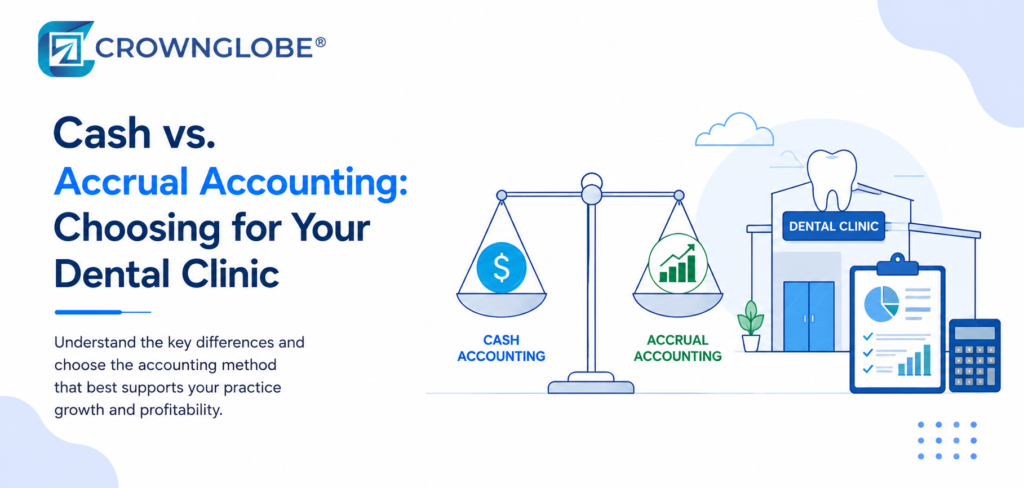
Running a dental clinic isn’t just about treating patients. Managing your bookkeeping and financial systems is really important because it helps you understand your dental business and make confident decisions, about your dental bookkeeping and financial systems.
When it comes to bookkeeping for your clinic you have to decide between cash and accrual accounting and the best choice for your clinic depends on how you run your clinic and your long-term goals, for your clinic.
Getting this means you will have better reports, smarter tax strategies and more clarity about your finances, over time.
Why Accounting for Dentists Requires the Right Method
Dental practices face financial challenges that are trickier than most other service businesses. There’s insurance reimbursements, patient billing cycles, payroll, and ongoing investments all of which make tracking income and expenses more complicated.
Dental accounting and bookkeeping need an well-structured approach that is supported by experienced dental accounting and bookkeeping professionals.
If you go with the wrong method, you can end up with:
- I want to see reports that actually show what is really going on with the project.
- Making cash flow decisions with incomplete info
- Surprises at tax time
- Not seeing your true profitability
Working with accountants, for dentists is really important because they help your system work correctly give you accurate reports and support long-term growth for your dentists business.
Cash vs Accrual Accounting (Quick Comparison)
Cash Accounting
- Record income only when you actually receive the payment.
- Record expenses when you pay them
- Simple, easy to handle
Accrual Accounting
- Record income when you earn it even if payment comes later
- Record expenses when they happen not just when paid
- Gives you a complete view of your finances.
The right choice depends on practice size and complexity.
What Is Cash Accounting in Dental Bookkeeping
Cash accounting is straightforward and where most dentists start. Here, you record revenue when money comes in and expenses as they’re paid.
It’s a good fit for smaller clinics or new practices since it tracks your actual cash and is easy to manage day-to-day.
When Cash Accounting Makes Sense
Cash accounting works well if:
- Your clinic is new or pretty small
- Transactions aren’t complicated
- You just want a simple view of your cash flow
Many clinics begin with basic bookkeeping for dentists using cash accounting and transition later as financial complexity increases.
Cash Accounting Limitations
It’s easy, but it has downsides:
- Doesn’t include outstanding insurance claims
- Makes revenue look inconsistent month to month
- Profit can look weird depending on timing
This matters in dental offices, where payments often get delayed.
Accrual Accounting in Dental Practices
Accrual accounting records everything when it happens even if cash hasn’t exchanged yet. You count income when you provide services and expenses when they’re incurred.
This gives you a more accurate read on your clinic’s performance.
Why Accrual Accounting Is Valuable
As your practice expands, accrual accounting pays off because it:
- Matches income with expenses in the right period
- Handles insurance receivables correctly
- Keeps financial reports consistent
- Helps with planning and forecasting
If you’re using professional dental accounting services and structured dental bookkeeping services, accrual accounting sets up your practice for deeper financial insight and better long-term planning.
How Cash vs Accrual Impacts You
1. Revenue Recognition
Cash: Record it when you get paid.
Accrual: Record it when the service is done.
That matters a lot with insurance delays.
2. Financial Insight
Cash: You get a basic overview.
Accrual: You see the full financial picture.
Accrual helps you know true profitability.
3. Taxes
Cash: Lets you pick when to count income
Accrual: More structured tax strategy
Having the right accountant keeps you compliant and efficient.
4. Growth
Cash: Easier to manage.
Accrual: Better for scaling up.
As your clinic grows, your accounting should, too.
Which Method Should You Pick?
There is no one size that fits everyone. The career change has some clear signs.
Go with Cash Accounting if:
- You’re just starting out
- You want things simple
- Your finances aren’t complex
Choose Accrual Accounting if:
- You’re growing or planning expansion
- You have multiple providers
- You bill lots of insurance
- You want deeper financial insights
Most established clinics end up switching to accrual as they grow.
When to Move from Cash to Accrual
Many practices start with cash accounting and switch as things get busier.
Consider switching if:
- Revenue grows steadily
- Reports feel off or confusing
- Insurance receivables pile up
- You need more precise forecasting
Don’t wing this transition work with an accountant who understands dental practices.
How Technology Helps
Modern accounting tech has made both methods easier to handle.
Using tools like QuickBooks for dentists, automation platforms, and dashboards such as Power BI, you can:
- Track transactions in real time
- Generate accurate reports
- Cut down on manual errors
These tools help you see your numbers clearly and act on them quickly.
Choosing the Right Method
If you just want simplicity, pick cash accounting.
If you need more accuracy and want to grow, accrual is the way to go.
For scaling practices, accrual makes more sense.
Whichever option you pick good dental bookkeeping is really important, for reporting, staying compliant and making smart decisions with your dental bookkeeping.
Mistakes to Avoid
Even with the right method, watch out for:
- Mixing methods without a plan
- Ignoring insurance receivables
- Using barebones bookkeeping
- Putting off financial reporting
Accountants who specialize in dentistry will keep your books accurate and compliant.
Internal Linking Opportunities
A strong accounting system could involve:
- Remote accounting services for flexibility
- Bookkeeping to keep records tight
- Outsourced accounting for scalable support
- Financial statements prep for clarity
- Virtual CFO services for bigger-picture planning
- Automation tools for real-time insights
Curious about how accounting boosts healthcare growth? Check out “How Chicago Medical Practices Can Improve Profitability Through Better Accounting in 2026.” Wondering about tax savings? Look at “What are Health Savings Accounts (HSA)?”
Compliance and IRS Rules
The IRS allows both cash and accrual accounting, but which you can use might depend on your practice’s setup.
As rules change, make sure to:
- Stay consistent in your reporting
- Keep proper documentation
- Align your accounting with tax filing
Use professional tax filing services to stay on the right side of compliance.
Conclusion
Choosing between cash and accrual accounting for your clinic is not a technical decision it shapes how you understand your clinic manage taxes for your clinic and plan, for the future of your clinic.
Starting with cash accounting makes sense for smaller clinics. As things get more complex, moving to accrual-based systems gives more clarity and control.
With dental bookkeeping the right tools and expert help your dental accounting can be a strong base, for making better decisions and achieving long-term success with your dental accounting.
FAQ
What’s the difference in dental practices?
Cash accounting records money when received; accrual counts it when earned. Accrual offers a clearer financial picture.
Which method is better for dentists?
Small practices often use cash, but growing clinics get more from accrual.
Can practices switch methods?
Yes, but transitions need to be planned and in line with IRS rules.
Does accrual accounting improve bookkeeping?
Absolutely. It’s more accurate, especially with insurance receivables and longer billing cycles.
What software is used?
QuickBooks is popular, along with automation and reporting tools.