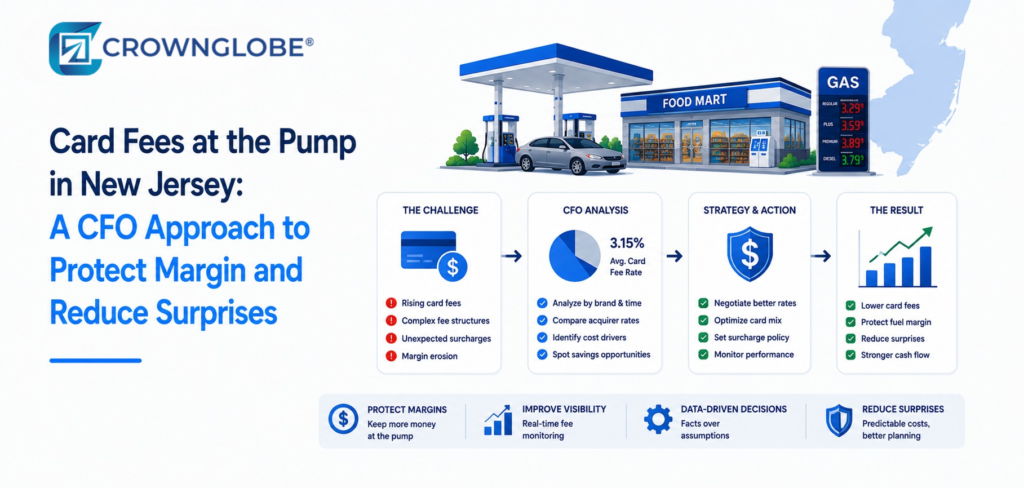
Running a gas station and convenience store in New Jersey today involves far more than managing fuel pricing and daily operations. One of the most underestimated costs is card processing fees at the pump.
As customer behavior continues to shift toward credit and debit payments, these fees have become a meaningful expense. They directly affect your fuel margins, often without being clearly visible in your day-to-day reporting.
Many operators only recognize the impact at the end of the month, when it is already too late to respond.
A structured CFO approach changes that dynamic. The service helps you understand your card fees so you can manage your costs and protect the profitability of your business.
Why Card Fees Matter More Than You Think
Fuel margins are already narrow. In many cases, you are working with only a few cents per gallon.
When card fees are added on top, they can quietly consume a meaningful portion of your already limited profit margin.
The cumulative impact on convenience stores and gas station operators can be substantial for those in high-volume locations, like convenience stores and gas stations.
Common challenges include:
- Limited visibility into how fees vary by transaction type
- No clear separation between pump transactions and in-store card usage
- Delayed understanding of how fees affect margins
- Lack of a defined strategy to manage or reduce costs
The cost of card fees is an expense that reduces the profitability of a business when it is not properly tracked.
Understanding Card Fees at the Pump
Card processing fees typically consist of:
- Interchange fees set by card networks
- Processor fees charged by your payment provider
- Fixed transaction charges
For fuel sales the costs are an issue because they are high-volume but low-margin transactions.
Even a small fee increase can greatly affect how money a gas station and convenience store makes, especially when they don’t make much to begin with.
The Hidden Problem: Lack of Real-Time Visibility
Most gas stations and convenience stores do not monitor card fees on a daily basis.
Instead, they rely on monthly processor statements. The problem is timing. By the time you review those statements, the margin impact has already occurred.
This lack of visibility often leads to:
- Missed opportunities to adjust pricing strategies
- Limited understanding of payment mix trends
- No proactive control over rising fee costs
A CFO-led system addresses this by integrating card fee data into your daily and weekly financial reporting.
CFO Approach to Managing Card Fees
A CFO does not simply report costs. The focus is on understanding cost drivers, controlling them effectively, and improving financial outcomes.
Break Down Fees by Category
Start by separating:
- Fuel-related card transactions
- Inside store card transactions
- Debit versus credit usage
This level of detail helps you see where fees are highest and where you can make adjustments to the fees.
Track Fees as a Percentage of Sales
Rather than focusing only on total fees, measure:
- Card fees as a percentage of fuel sales
- Card fees as a percentage of inside store sales
This gives a picture of how fees are affecting the margins of your business.
Monitor Daily and Weekly Trends
With structured reporting in place, you can track:
- Shifts in customer payment behavior
- Fee trends over time
- The impact of pricing or operational changes
This becomes especially valuable when evaluating a gas station and convenience store for sale in NJ or expanding into nearby markets like Pennsylvania or Virginia.
Using Power BI for Card Fee Visibility
Manual tracking rarely provides the level of clarity needed to make timely and informed financial decisions.
With Power BI visualization, you can build dashboards that highlight:
- Card fees by location
- Payment type breakdowns
- Fee trends over time
- Direct impact on fuel margins
When combined with finance automation, your data updates automatically, giving you a real-time and reliable view of performance.
Pricing Strategy: Protecting Fuel Margins
Fuel pricing decisions must account for card fee impact.
A structured pricing approach considers:
- Local competitive pricing
- Customer payment behavior
- Margin sensitivity
Some operators explore cash discount programs or pricing adjustments. They must do it carefully, so they do not break state rules.
Multi-Location Impact
If you operate multiple gas stations and convenience stores, card fee impact can vary significantly by location.
This variation is influenced by:
- Customer payment preferences
- Local competition
- Transaction volume
A centralized dashboard allows you to:
- Compare fee impact across locations
- Identify higher-cost stores
- Standardize pricing and operational policies
For operators managing convenience stores and gas stations, this level of visibility is essential for maintaining control and consistency.
Compliance and Regulatory Considerations
Card fee strategies must align with both state and federal requirements.
Key considerations include:
- Regulations around surcharging and cash discounts
- Customer disclosure requirements
- Accurate financial reporting for tax purposes
You also need proper classification aligned with NAICS code for gas station and convenience store and the correct activity code for gas station and convenience store.
Additionally, requirements such as florida gas station and convenience store insurance highlight the importance of maintaining accurate and consistent financial reporting across multiple states.
Common Mistakes That Reduce Margins
Many operators unintentionally increase their costs due to avoidable gaps such as:
- Not reviewing processor agreements regularly
- Overlooking changes in fee structures
- Limited visibility into payment mix
- No benchmarking across locations
- Treating card fees as a fixed, unavoidable expense
This is super important when buying gas stations and convenience stores because unclear finances can lead to costly mistakes.
Tax and Financial Considerations
Card processing fees are generally deductible business expenses, but accurate tracking is essential.
Proper reporting helps you:
- Capture all eligible deductions
- Maintain clean records for tax filing
- Prepare reliable financial statements
For details check out Maximizing Tax Deductions and Credits for Retail Stores and Tax Planning Strategies, for Retail Stores.
How Crownglobe Helps Manage Card Fees
Crownglobe supports gas station and convenience store owners with financial systems designed to bring clarity and control to complex cost structures.
This includes:
- Virtual CFO services
- Power BI dashboards
- Finance automation
- Bookkeeping and outsourced accounting
- Financial statements preparation
- Payroll processing and compliance support
This approach is designed to give you clear financial visibility and support better decisions that improve profitability and long-term performance.
Conclusion
Card fees at the pump are not just another operating expense. They are a variable that directly affects your margin.
For a gas station and convenience store, even small improvements in managing fees can lead to meaningful gains in profitability.
With a CFO approach, you get the visibility, control, and confidence to make smart financial decisions.
FAQ Section
How do card fees impact gas station margins?
Card fees reduce already thin fuel margins, particularly on high-volume transactions.
Can gas stations reduce card processing fees?
Yes. By reviewing fee structures, optimizing pricing strategies, and negotiating with providers, costs can often be improved.
Should gas stations use cash discount programs?
Some operators do, but these programs must comply with state regulations and proper disclosure requirements.
How often should card fees be reviewed?
Weekly tracking is recommended to identify trends and make timely adjustments.
Are card processing fees tax deductible?
Yes. In most cases, they are treated as deductible business expenses.