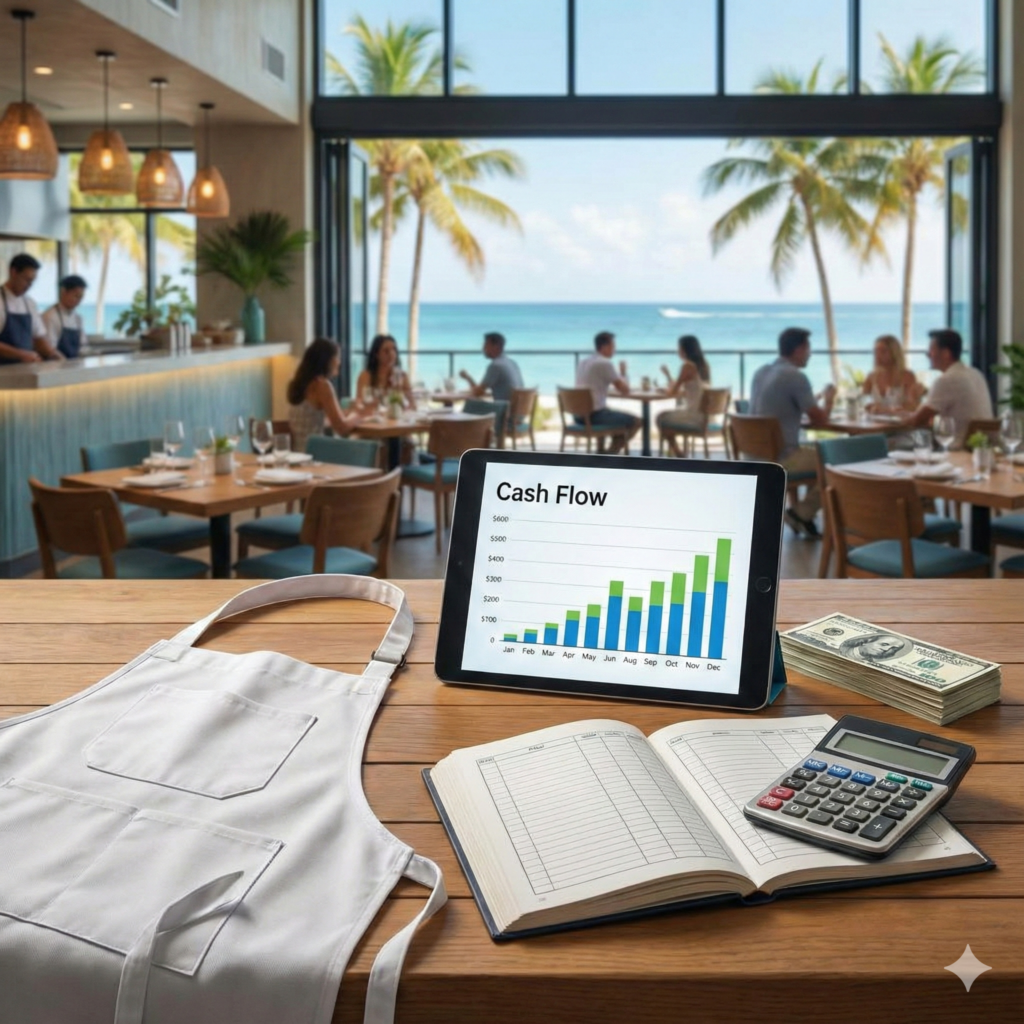
Cash flow is the lifeline of a restaurant. It determines whether you can pay payroll, purchase inventory, cover rent, settle vendor bills, and keep operations running without stress. In Miami’s restaurant industry where margins are thin, competition is intense, and costs fluctuate weekly cash flow determines whether your business survives or fails.
- Here is the truth every Miami restaurant owner eventually learns the hard way:
- Most restaurants do not run out of profit.
- They run out of cash.
Profit on paper means nothing if cash is not available at the right time. And the number one cause of cash flow crises in Miami restaurants is not the economy, not seasonality, not customers spending less, and not tourism cycles.
It is inaccurate accounting.
After more than ten years analyzing restaurant books across Florida, I have seen profitable restaurants fail because their financial system was weak. Miami restaurants are especially vulnerable because of the fast pace, high operational cost, and heavy reliance on multiple revenue channels like dine in, online delivery, pickup, catering, and events.
This guide explains exactly how accurate accounting prevents cash flow emergencies, what Miami restaurants do wrong, and how to fix these issues immediately to protect your profitability.
Why Cash Flow Problems Are Worse for Miami Restaurants
- Miami restaurant owners face a unique set of financial pressures:
- High rent
- High labor costs
- High utility bills
- High food cost volatility
- High supplier price changes
- High credit card fees
- High competition
- Seasonal revenue swings
- Rapid inventory movement
- Delivery app commissions
- Even a small accounting mistake can create major cash flow damage.
- Cash flow problems never happen overnight.
- They build slowly because the numbers are wrong.
- Below are the twenty nine reasons restaurants in Miami run out of cash because their accounting is inaccurate or delayed.
- When books are inaccurate:
- You overspend without realizing it
- Food cost appears lower than it is
- Labor appears manageable when it is not
- Tax estimates become incorrect
- Inventory gets miscalculated
- Payroll forecasts become unreliable
- Vendor payments fall behind
How Poor Accounting Creates Cash Flow Crises
1. Incorrect Food Cost Reporting
Food prices change constantly in Miami. A five percent increase in food cost can wipe out your entire profit.
- Without accurate weekly tracking, you never see:
- Margin drops
- Waste issues
- Portion control problems
- Shrinkage
- Vendor overpricing
- This directly destroys cash flow.
- If labor cost is not updated daily, you cannot forecast payroll.
- This leads to payroll surprises and cash shortages.
- When bills are misc expensed, your financial reports are worthless and cash flow cannot be predicted.
- Incorrect reconciliation hides real cash flow.
- Inventory affects food cost and cash flow directly.
- you cannot calculate accurate COGS or predict inventory cash requirements.
- If waste is not tracked, cash leaks increase.
- Payroll is often the largest weekly cash requirement.
- This is a major cause of cash flow crises.
2. Ignoring Delivery App Deductions
- Delivery platforms deduct:
- Commissions
- Marketing fees
- Refunds
- Adjustments
- Promo credits
- Many restaurant owners only see the net deposit and assume it is revenue. This leads to:
- Incorrect sales reporting
- Incorrect tax filing
- Cash flow deficits
3. Incorrect Labor Cost Calculations
- Miami restaurants often pay:
- Servers
- Line cooks
- Prep workers
- Bartenders
- Runners
- Host staff
- Dishwashers
- Managers
- Expeditors
4. Not Categorizing Vendor Bills Correctly
- Vendor bills include:
- Food
- Beverage
- Cleaning supplies
- Smallwares
- Repairs
- Paper goods
- Chemicals
5. Failing to Reconcile Merchant Fees
- Credit card processors take:
- Two to four percent in fees
- Chargeback penalties
- Dispute fees
- Monthly software charges
6. No Weekly Inventory Tracking
- If you do not track:
- Beginning inventory
- Purchases
- Ending inventory
7. Ignoring Shrinkage and Waste
- Miami restaurants have higher shrinkage due to:
- Tourism
- Employee turnover
- Bar operations
- High liquor margin
- High food movement
8. Not Forecasting Payroll
- Without accurate labor reports, you cannot:
- Predict cash needs
- Schedule efficiently
- Avoid overtime blowouts
9. Not Differentiating Food vs Liquor vs Beverage Margins
Food margins are different from liquor margins.
If everything is lumped together, your cash flow insights are distorted.
10. Not Preparing Weekly P and L Statements
Monthly P and L is too late.
Quarterly P and L is a financial disaster.
11. Not Tracking Catering Orders Separately
- Catering requires:
- Additional labor
- Inventory variance
- Delivery cost
- Prep time
Without separation, cash flow becomes unpredictable.
12. Not Reconciling Delivery App vs POS Sales
- Your POS may show 3000 in delivery sales.
- Your bank may receive only 2100 after app deductions.
- This mismatch must be tracked.
13. Not Accounting for Voids and Discounts
Voids, comps, and discounts reduce revenue.
Ignoring them inflates profit and reduces cash clarity.
14. Poor Sales Tax Tracking
Florida imposes penalties on late or incorrect sales tax reporting.
Sales tax errors happen when accounting is inaccurate.
15. Incorrect Payroll Classification
- Servers receive tips.
- Kitchen staff do not.
- Managers receive salaries.
- Bartenders have allocated tips.
- Incorrect classification leads to:
- IRS penalties
- Payroll tax errors
- Cash flow disturbances
16. Late or Incorrect Vendor Payments
Miami restaurants rely heavily on trusted vendor relationships.
- Late payments lead to:
- COD terms
- Higher pricing
- Restricted deliveries
- This crushes cash flow.
17. Not Tracking Daily Sales Deposits
- POS says you made 5000.
- Your bank shows 4400.
Where did the other 600 go?
- Without accurate accounting, you cannot answer this simple question.
- Failing to forecast is the fastest way to fail.
- Depreciation affects taxes and cash planning.
- lose thousands in deductions when depreciation is ignored.
- Incorrect tracking leads to IRS letters and cash flow penalties.
- Without separation, your P and L is misleading.
18. No Cash Flow Forecasting
- Restaurants need forecasting to manage:
- Rent
- Payroll
- Vendor bills
- Utilities
- Inventory cycles
19. Not Using Accounting Software Designed for Restaurants
- General accounting systems miss:
- Recipe costing
- Portion control
- Yield tracking
- POS integration
- Food cost automation
- Multi revenue channel tracking
- Restaurants need systems like:
- Restaurant365
- MarginEdge
- QuickBooks Online with restaurant add ons
- Toast
20. Not Tracking Equipment Depreciation
- Restaurants with:
- Ovens
- Refrigerators
- Dish machines
- Ice machines
- Freezers
- Furniture
21. Inaccurate Reporting of Tips and Service Charges
- Miami restaurants often have:
- Credit card tips
- Cash tips
- Service charges
- Gratuity policies
22. Not Separating Dine In vs Delivery vs Online Sales
- Each has different:
- Margins
- Commissions
- Operational costs
23. No Budgeting for Repairs and Maintenance
Restaurants require constant repairs.
Without planning, unexpected costs destroy cash flow.
24. No Tracking of Prepaid Expenses
- Restaurants prepay:
- Insurance
- Subscriptions
- Software
- Licenses
- Incorrect recording distorts monthly cash flow.
- Incorrect tracking misrepresents cash position.
- Without dashboards, owners fly blind.
25. No Tracking of Gift Cards and Loyalty Programs
- These create:
- Liabilities
- Delayed revenue
- Deferred cash recognition
26. Not Using a Cash Flow Dashboard
- Modern accounting shows:
- Daily cash burn
- Weekly vendor requirements
- Monthly payroll projections
- Expected deposits
27. Not Separating Each Shift’s Sales and Labor
Morning, afternoon, and evening shifts have different economics.
Not separating them hides problems.
28. Overestimating Sales and Underestimating Expenses
This happens when accounting is outdated or inaccurate.
29. Only Checking Bank Balance Instead of Financial Reports
This is the most dangerous habit among Miami restaurant owners.
Your bank balance is never an accurate picture of your financial health.
How Accurate Accounting Prevents Every Cash Flow Crisis
When your accounting is accurate and updated weekly or monthly at the minimum you get complete financial clarity.
Here is what accurate accounting fixes:
- Predictable Inventory Spending You know exactly how much you need to spend each week.
- Exact Payroll Forecasting You will never be surprised by payroll again.
- Real Time Profit Margins You know which menu items are profitable and which are not.
- Zero IRS Issues Accurate books eliminate: • Sales tax mistakes • Payroll mistakes • Income reporting errors • Tip reporting mismatches
- Accurate Cash Flow Charts You can see: • When cash will run out • When to slow ordering • When to cut labor • When to adjust menus • When to run promotions
- Better Vendor Negotiation Accurate ordering reduces waste and increases bargaining power.
- Stronger Pricing Decisions You can raise prices intelligently instead of guessing.
- Clean Monthly Financial Statements These are essential for: • Loans • Investors • Landlords • Business expansion • Exit planning
Systems Miami Restaurants Need in 2026
To prevent cash flow crises, Miami restaurants should use:
- Restaurant365 or MarginEdge For food cost tracking and inventory.
- QuickBooks Online For accounting and reconciliation.
- Toast or Clover For POS integration.
- Gusto or ADP For payroll automation.
- Weekly restaurant KPIs For real time monitoring.
- If you read this “The Ultimate Bookkeeping System for E Commerce Businesses in Miami” .
Frequently Asked Questions About Cash Flow in Restaurants
Why do most restaurants fail in Miami?
Because they run out of cash long before they run out of customers.
How often should Miami restaurants update their books?
Weekly is ideal. Monthly is the minimum.
What software helps with cash flow?
Restaurant365, Toast, MarginEdge, and QuickBooks Online.
Do delivery apps hurt cash flow?
Yes. Commissions reduce net revenue and must be tracked precisely.
Can accurate accounting increase profit?
Absolutely. Proper accounting can increase restaurant profit by ten to twenty percent.
Can AI automate restaurant accounting?
Yes. AI automates most entries, but human oversight is required.
Conclusion
Cash flow is the heartbeat of every Miami restaurant. When accounting is inaccurate, delayed, or incomplete, cash flow collapses rapidly even if sales appear strong. Accurate accounting provides the real numbers, the full financial picture, and the insights needed to make smarter operational decisions.
Miami restaurant owners who rely on accurate weekly and monthly accounting have stronger cash flow, fewer IRS problems, better vendor relationships, and higher margins. Those who guess, delay, or ignore the numbers always end up in financial trouble.
Crownglobe continues to help Miami restaurants build accurate accounting systems, prevent cash flow crises, and protect profit margins in an industry where financial clarity determines survival.
Accurate accounting is not a luxury.
It is survival.