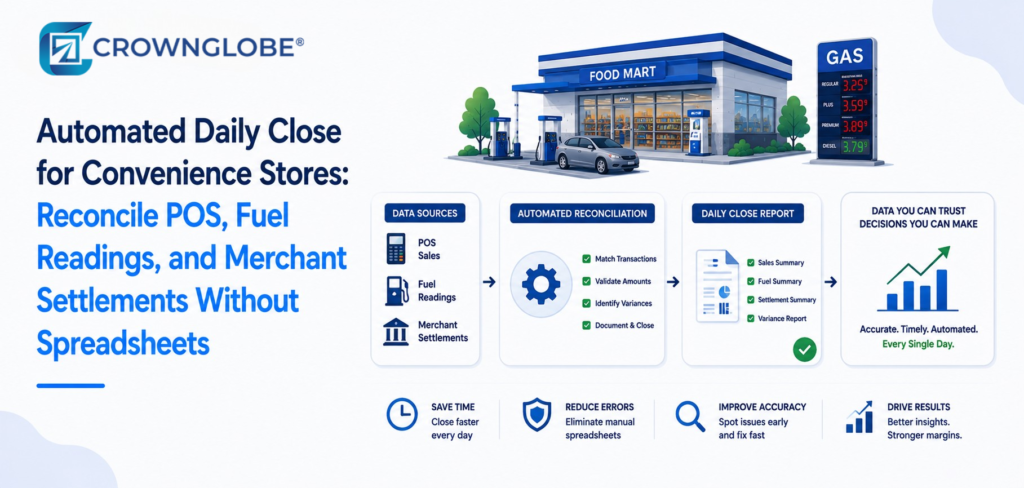
Running a gas station and convenience store today means handling lots of transactions from fuel sales, in-store purchases, and different payment methods. Whether you are owning a convenience store and gas station or scaling across locations, this complexity increases quickly.
At the center of all this activity is your daily close. If that process is manual or inconsistent, your numbers become harder to trust.
Many operators still rely on spreadsheets. While familiar, they rarely keep pace with the complexity of modern operations and often introduce more problems than they solve.
An automated daily close changes the dynamic. It connects your systems, reconciles your data accurately, and gives you a clear financial picture at the end of each day.
Why Daily Close Matters More Than You Think
Your daily close is more than an accounting routine. It is one of the most important control mechanisms in your business.
When done correctly, it allows you to:
- Catch cash shortages early
- Identify fuel variances before they grow
- Match sales with actual deposits
- Maintain accurate, audit-ready financial records
For operators running a convenience store and gas station, understanding the difference between gas station and convenience store revenue is really important because they have ways to make money and accept payments.
Small inconsistencies can build into financial problems over time if you do not have a structured process in place for managing your money.
What Needs to Be Reconciled Daily
A complete daily close in gas stations and convenience stores goes beyond checking POS totals.
You need to reconcile three key areas.
POS Sales Data
Your POS system records:
- Fuel sales
- Inside store transactions
- Lottery and tobacco sales
- Discounts and promotions
This forms the base layer of your financial reporting. If this is not aligned, everything downstream is affected.
Fuel Readings and Deliveries
Fuel reconciliation involves matching:
- Pump readings
- Tank levels
- Fuel deliveries
- Sales volumes
Even small variances can point to:
- Meter calibration issues
- Delivery discrepancies
- Shrinkage or operational loss
For any gas station and convenience store, this is a critical control point that cannot be overlooked.
Merchant Settlements and Deposits
Card transactions add another level of complexity.
You need to reconcile:
- POS card sales
- Merchant processor settlements
- Bank deposits
Differences often arise from:
- Processing fees
- Settlement timing differences
- Missing or delayed transactions
Without proper reconciliation, your reported revenue may not reflect your actual cash flow.
The Problem with Spreadsheet-Based Close
Spreadsheets are still widely used, but they introduce limitations as your business grows.
Over time, they create:
- Manual entry errors
- Delays in reporting
- Limited visibility into discrepancies
- No reliable audit trail
- Difficulty managing multiple locations
For a chain of convenience stores and gas stations, this approach quickly becomes inefficient and risky.
How Automation Transforms the Daily Close
Automation changes your job from entering data to supervising it so you check reports. Take action on them instead of making them.
Data Integration Across Systems
Modern tools connect your:
- POS system
- Fuel management software
- Accounting platform
- Bank feeds
This creates a single, consistent data flow across your business.
Operators who combine finance automation with remote accounting services often see immediate gains in both accuracy and speed.
Real-Time Reconciliation
With automation, you can:
- Match sales and deposits daily
- Monitor fuel variances automatically
- Identify discrepancies as they happen
This reduces errors and strengthens financial control across your operation.
Exception-Based Reporting
Rather than reviewing every transaction, your attention is directed to what matters.
The system flags:
- Cash over or short issues
- Fuel variance exceptions
- Missing or delayed deposits
This allows you to focus on resolving issues quickly instead of searching for them.
CFO Perspective: Why Daily Close Drives Better Decisions
From a CFO standpoint, the quality of your daily close determines the reliability of everything that follows.
If your daily numbers are not right then your weekly and monthly insights will also be wrong.
A structured close process supports:
- Weekly financial reporting
- Accurate financial statements preparation
- Reliable cash flow forecasting
- KPI tracking through Power BI visualization
This becomes especially important when evaluating a gas station and convenience store for sale in Florida or planning expansion across multiple states.
Multi-Location Complexity and Control
As your business grows, consistency becomes critical.
A standardized daily close allows you to:
- Compare performance across locations
- Identify issues early
- Maintain consistent financial controls
Managing a convenience store and gas station in places like Texas, New Jersey or Pennsylvania requires consistency especially when evaluating a gas station and convenience store for sale, in North Carolina, New Jersey or Pennsylvania.
Compliance and Structural Considerations
A daily close that is done properly also helps with following the rules and regulations.
You need to ensure:
- Sales classification aligns with the NAICS code for gas station and convenience store and supports structured reporting similar to a sample business plan for gas station and convenience store
- Proper tracking of taxable and non-taxable sales
- Reporting aligns with the correct activity code for gas station and convenience store
It also supports requirements such as florida gas station and convenience store insurance, where accurate financial reporting is expected.
Common Mistakes in Daily Close Processes
Many operators face similar challenges:
- Skipping daily reconciliation
- Relying on summary reports instead of detailed matching
- Overlooking fuel variances
- Ignoring settlement timing differences
- Inconsistent processes across locations
These issues are common especially when people who run gas stations and convenience stores want to sell them but do not have a system to handle money.
Practical Workflow: Automated Daily Close
A structured workflow typically follows five steps:
Step 1: Data Capture
POS, fuel, and bank data are captured automatically
Step 2: Reconciliation
Sales, deposits, and fuel data are matched
Step 3: Exception Identification
The system highlights discrepancies
Step 4: Review and Action
You investigate and resolve issues
Step 5: Reporting
Data feeds into dashboards and financial reports
This consistent process ensures accuracy and reliability every day.
Tax and Financial Impact
Accurate daily reconciliation strengthens your financial and tax position.
It helps you:
- Track revenue with precision
- Identify deductible expenses
- Maintain clean records for tax filing
- Prepare accurate year-end financial statements
For information check out Maximizing Tax Deductions and Credits for Retail Stores and Tax Planning Strategies, for Retail Stores.
How Crownglobe Helps Automate Daily Close
Crownglobe supports gas station and convenience store owners with systems designed to eliminate manual processes and improve financial clarity.
This includes:
- Finance automation for daily reconciliation
- Bookkeeping and outsourced accounting
- Virtual CFO services
- Power BI dashboards
- Payroll processing and compliance
- Year-end financial review and cleanup
The approach is practical and focused: helping you build a system that supports both daily operations and long-term growth.
Conclusion
For a gas station and convenience store, the daily close is not just a routine task. This system is, like a shield that protects your business.
When set up and automated properly it gives data, quicker insights and better decision making.
Moving away, from spreadsheets to an integrated system gives gas stations and convenience stores the confidence to scale and operate with clarity.
FAQ Section
What is a daily close in a gas station and convenience store?
It is the process of reconciling POS sales, fuel readings, and payment settlements to ensure accurate financial records each day.
Why should daily close be automated?
Automation reduces manual errors, improves efficiency, and provides real-time visibility into financial performance.
What systems are involved in daily reconciliation?
POS systems, fuel management software, accounting platforms, and bank feeds are typically integrated.
How does daily close impact profitability?
It helps identify discrepancies early, reduce losses, and support better financial decisions.
Can automation help multi-location operators?
Yes. It standardizes processes and improves visibility across all locations.
What should be included in a daily close process for a gas station and convenience store?
A daily close should include reconciliation of POS sales, fuel readings, merchant settlements, and proper classification aligned with NAICS or activity codes to ensure accurate reporting and compliance.