Dental Practice Accounting & Bookkeeping Services
Dentists and orthodontists require specialized financial management. At Crownglobe, we know dental offices have unique challenges from insurance billing quirks to expensive equipment leases. Our tailored services include:
Book Your Free ConsultationAccounts Payable
Process vendor invoices for lab work and equipment service and schedule payments to keep relationships, with vendors.
Expense Management
I need to keep track of the costs of my supplies and also the lab bills and the equipment.
Payroll & Benefits
I need to process payroll for the hygienists and the front-desk staff and also manage the retirement plan contributions, for them.
Tax Compliance
You need to set aside money for taxes & get ready to do the year end paperwork like filling out a Schedule C or corporate tax return, for your business the quarterly taxes & year-end filings.
The company is really focused on following HIPAA rules and using software, like Dentrix and Eaglesoft to make things work better.
Dental Industry Accounting Challenges
Dental practices manage complex financial operations that require accurate bookkeeping, insurance tracking, compliance management, and organized reporting systems. Without industry-specific accounting processes, dental offices can face cash flow issues, reporting errors, and operational inefficiencies that affect profitability.
Our accounting solutions help dental practices manage insurance reimbursements, patient balances, co-pays, payment plans, and supply expenses with accuracy and consistency. We also support equipment depreciation tracking, multi-location accounting, and reconciliation of insurance payments and patient collections.
With organized bookkeeping workflows, compliance-focused reporting, and improved financial visibility, we help dental offices reduce errors and operate more efficiently. Our goal is to create reliable financial systems that support smoother operations, stronger cash flow management, and long-term practice growth.
Contact Us

Insurance Billing & Delays
Dental offices have to wait for insurance companies to pay them. This can take days or weeks which is a problem because it affects the money they have to run their dental offices.

Patient Payment Complexity
People who go to the doctor may have to pay some money upfront. They may still owe money or they may have a plan to get some of that money back and the hospital has to keep track of all this money very carefully so they do not lose any of the doctor visit money.

Inventory & Supplies Costs
Dental supplies, such, as anesthetics and crowns and implants have a high turnover rate and the dental supplies are very expensive. .Without inventory accounting, small practices lose track of supplies expenses.

Regulatory Compliance
Dental practices need to follow HIPAA rules for information and IRS rules for medical expenses so they do not get in trouble for things, like misreporting medical expenses or not giving 1099 forms to lab suppliers.

Equipment Depreciation
Dental equipment like chairs and X-ray machines is really expensive and it loses value over the years so tracking this loss is very important, for getting the most tax deductions.

Multi-location Oversight
Dental groups with offices need reports that show details, for each office so they can see how well each one is doing financially. These factors make dental bookkeeping complex. Crownglobe specializes in resolving them so dentists can focus on smiles, not spreadsheets.
How Crownglobe Solves Them
Our dental accounting system is designed for your practice’s needs:
Automated Posting
Dental groups with offices need reports that show details, for each office so they can see how well each one is doing financially.
Insurance Reconciliation
When claims are not paid in full the system flags them away so the staff can follow up on these unpaid claims and try to reduce the amount of write-offs for these unpaid claims.
Patient Ledger Management
All patient payments and their outstanding balances are being tracked. We generate statements for patients with due co-pays, improving collections.
Expense Categorization
Expenses are coded by type (supplies, lab work, rent, utilities). We also set up cost centers (e.g. Prosthodontics, Orthodontics) for larger practices to monitor each service line’s profitability.
Depreciation & Capital Assets
Our team records each equipment purchase in the fixed asset ledger and calculates depreciation for tax reporting. This ensures maximum permissible deductions.
Tax Ready Reporting
We prepare all necessary reports for your CPA. By year-end, your dental practice will have Schedule C or corporate tax statements organized, including all Medicaid/Medicare receipts.
Dental Bookkeeping Services
Stay informed with expert financial tips and industry updates.

Daily Transaction Entry
Document all receipts, such as insurance checks, patient payments and credit card batches, into your ledger accurately every day.

Accounts Payable
Process vendor invoices for lab work and equipment service and schedule payments to keep relationships, with vendors.

Payroll & Benefits
Process vendor invoices for lab work and equipment service and schedule payments to keep relationships, with vendors.

Inventory & Supplies Accounting
Track purchases of gloves, fillings and dental implants. Adjust for usage to prevent supply shortages and spot waste.

Financial Reporting
Monthly profit and loss statements & balance sheets give visibility & we include key dental metrics like revenue, per dentist & average collection period.

Consulting & Budgeting
We need to think about how much to charge for procedures and make budgets like figuring out if raising the price of teeth whitening can help us make more money.
Industry-Specific Benefits
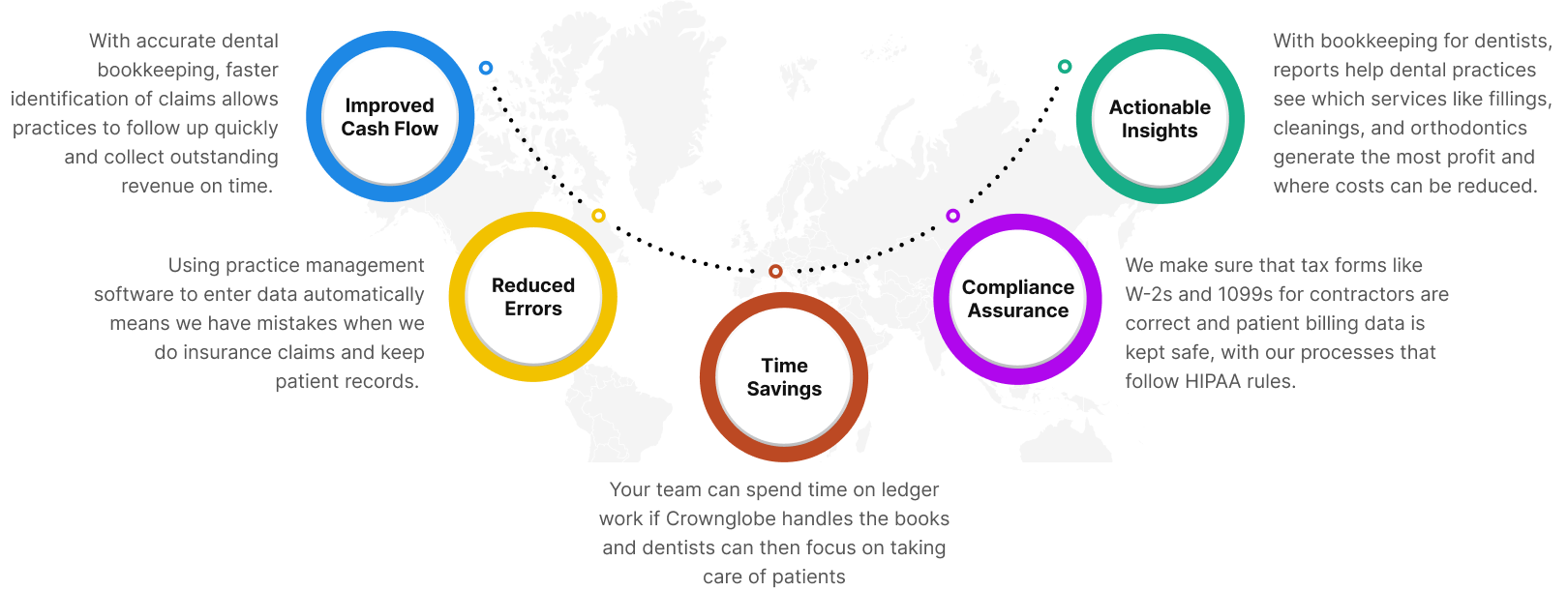
Improved Cash Flow
With accurate dental bookkeeping, faster identification of claims allows practices to follow up quickly and collect outstanding revenue on time.
Reduced Errors
Using practice management software to enter data automatically means we have mistakes when we do insurance claims and keep patient records.
Time Savings
Your team can spend time on ledger work if Crownglobe handles the books and dentists can then focus on taking care of patients
Compliance Assurance
We make sure that tax forms like W-2s and 1099s for contractors are correct and patient billing data is kept safe, with our processes that follow HIPAA rules.
Actionable Insights
With bookkeeping for dentists, reports help dental practices see which services like fillings, cleanings, and orthodontics generate the most profit and where costs can be reduced.
Data-driven strategy
KPI Dashboards
We set up dashboards using Microsoft Power BI to track things like occupancy rates, for appointments and average procedure value and days sales outstanding.
Revenue Forecasting
Crownglobe predicts cash flow to ensure you have reserves for equipment maintenance or expansion.
Profitability Analysis
Break down profitability by dentist or service. Find out if high-cost procedures cover their costs.
Financial Planning
Our CFO team helps plan for growth – such as adding a new hygiene room or launching a cosmetic suite – by modeling costs and ROI.
Case Study
Bright Smile Dental Multi Doctor Practice
Challenge
The dental clinic faced ongoing difficulties managing payroll and bookkeeping while handling day-to-day patient operations. Manual processes made it challenging to track employee payments, maintain accurate financial records, and stay compliant with payroll regulations. As the practice grew, administrative tasks became increasingly time-consuming, leaving staff overwhelmed and increasing the risk of payroll errors, reporting inaccuracies, and compliance issues. The lack of streamlined accounting processes also limited financial visibility, making it difficult for management to focus on business growth and patient care.

Solution
Bright Smile Dental had 3 locations and grew rapidly. Their in-house bookkeeping struggled to keep up with insurance complexities and tracking each doctor’s revenue. They were losing money on uncollected co-pays and couldn’t easily see which branches were profitable.
Results
Outstanding patient balances dropped 30% in two months as statements were issued promptly. One underperforming branch was identified (high overhead, low collections) and corrective measures (staff training, adjusted fees) were taken. Over the first year, practice revenue increased 12% while accounting costs stayed fixed.
Benefits
We empower your business with

Dental PM Software
Dentrix, Eaglesoft and Open Dental are used for billing and charting.

Accounting Systems
I am looking for accounting software, like QuickBooks Online or Xero that is tailored for location practices.

Scheduling/Payments
Solutionreach and Weave are used for sending reminders and handling payment processing.

BI & Reporting
You can use Microsoft Power BI or Tableau to make dashboards that you can look at from any device.

Automation
I use A2X for my e-commerce business when I sell supplies & I also use Bill.com to make payments, to vendors & Expensify to track my expenses.
Engagement Model
Start with Standard $125/ Per Month Monthly bookkeeping and financial statements ideal for solo practitioners and small clinics.
Start with Growth $245/ Per Month Includes Standard plus enhanced reporting and quarterly strategy sessions, perfect for growing multi-dentist practices.
Start with Virtual CFO $345/ Per Month The Growth features are really good. They also have full forecasting and BI dashboards and you get priority support, which is great, for big dental groups or Dental Service Organizations.
FAQs
The forms depend on your legal structure. A sole proprietorship (or single-member LLC) reports business income on Schedule C of your Form 1040. Partnerships file Form 1065 and issue K-1s to partners. C corporations use Form 1120, and S corporations use Form 1120-S. (Each partner or S-corp shareholder then reports income on their personal returns.) Sole proprietors also use Schedule SE (Form 1040) to calculate self-employment taxes. In addition, you may need to file employment tax returns (e.g. Forms 941/940) if you have employees. Always check IRS instructions for any information returns (1099-NEC, 1099-K, etc.) required based on your payments or receipts.
Due dates vary by business type. Partnerships and S corporations generally must file by March 15. Sole proprietorships and C corporations typically file by April 15. If these dates fall on a weekend or holiday, the deadline moves to the next business day. Estimated tax payments are usually due quarterly on April 15, June 15, September 15, and January 15.
Most business taxes can be filed electronically through IRS Free File, commercial tax software, or a tax professional. E-filing is generally faster and more accurate than paper filing.
The Business Tax Account is a digital platform that allows business owners to view their tax records, make payments, and manage their account with the IRS. While not mandatory, it is highly recommended for easier management of business tax obligations.
You should keep all records that support an item of income, deduction, or credit on your tax return. Generally, the IRS recommends keeping records for at least three to seven years, depending on the nature of the document.
Common deductions include office rent, utilities, supplies, travel expenses, employee wages, and insurance. To be deductible, a business expense must be both ordinary and necessary in your trade or business.
The QBI deduction allows eligible self-employed individuals and small business owners to deduct up to 20% of their qualified business income from their federal taxes.
Available credits include the Small Business Health Care Tax Credit, the Work Opportunity Tax Credit, and Research and Development (R&D) credits, among others.
If you expect to owe $1,000 or more in taxes when you file your return, you generally must make quarterly estimated tax payments throughout the year.
You need an Employer Identification Number (EIN) if you have employees, operate as a corporation or partnership, or file certain tax returns. You can apply for an EIN for free on the IRS website.
This depends on whether you have a “nexus” (significant presence) in other states. Many states have laws requiring remote sellers to collect sales tax if they exceed certain sales thresholds.
The best way to avoid penalties is to file your returns on time and pay any taxes owed by the due date. If you can’t pay, file anyway to avoid the failure-to-file penalty.
Key changes for 2025 include updated tax brackets for inflation, adjustments to standard deductions, and potential new rules regarding digital assets and clean energy credits.
Starting in 2024, the threshold for reporting payments on Form 1099-K has been adjusted. It’s important to track all third-party network payments to ensure accurate reporting.
Employers are responsible for withholding federal income tax, Social Security, and Medicare taxes from employee wages, as well as paying their own share of Social Security and Medicare taxes.
Accelerate Your Business Growth
Discover our core solutions designed to streamline your financial operations and branding.
Connect with us
Don’t let bookkeeping headaches distract from patient care. Crownglobe’s dental accounting experts ensure your practice’s finances are always in peak condition.Contact us today to schedule a consultation. We’ll show how modern, dentist-focused bookkeeping can strengthen your practice’s financial health.
Book Free Consultation