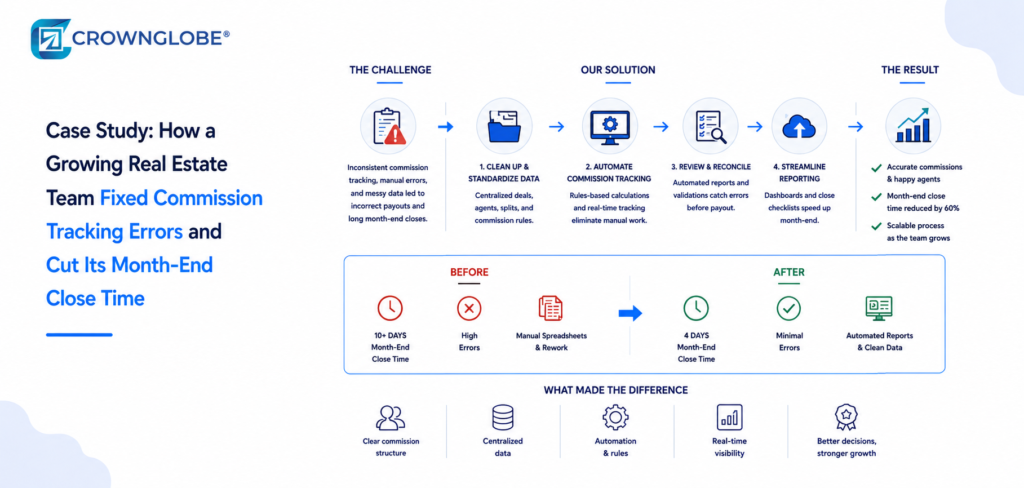
A real estate team was having trouble, with tracking commissions delayed reports and not knowing how profitable they were. They fixed their bookkeeping made commission workflows the same for everyone, automated reports and created management dashboards. This helped them close their month in under a week instead of nearly three weeks. They improved their commission tracking and financial reporting.
The outcome was more than just faster reporting. The team gained more accurate commission calculations, stronger financial controls, better visibility into performance, and greater confidence when making business decisions.
The Challenge: Growth Was Creating Reporting Problems
Growth is a thing for any brokerage but it can also show the problems, in the systems that used to work just fine for the brokerage.
The real estate team, in this story had grown fast over a few years with more agents joining, a lot more transactions happening and the way they got paid becoming more complicated.
From the outside, the business appeared to be thriving.
Behind the scenes, however, leadership was dealing with several recurring reporting challenges:
- Commission calculations regularly required manual adjustments
- Financial statements were arriving weeks after month-end
- Agent payout questions consumed valuable management time
- Reports from different systems often failed to align
- Leadership lacked clear visibility into profitability by team and agent
The bookkeeping process that supported the company during its earlier growth stages was no longer providing the accuracy and visibility the business needed.
This is a common challenge for growth-stage brokerages and real estate firms. As transaction volume increases and operations become more complex, strong real estate accounting becomes essential for maintaining control and supporting informed decision-making. Whether supported by experienced real estate bookkeepers, structured real estate agent bookkeeping processes, or modern accounting software for real estate brokerage operations, accurate reporting becomes increasingly important as firms scale.
Understanding the Root Cause
At first, management believed the issue was technology.
After taking a closer look at the reporting workflow, it became clear that the real problem was not software. It was the way information moved through the organization.
The brokerage relied on multiple disconnected systems:
- CRM software
- Commission tracking spreadsheets
- Accounting software
- Banking platforms
- Payroll records
The same information was often entered more than once.
Data frequently differed between systems.
Month-end reporting required extensive manual reviews and reconciliations before financial statements could be finalized.
The company did not have a technology problem.
It had a process problem.
Snippet Block: The Biggest Reporting Bottleneck
The largest reporting challenge was not the commission calculations themselves.
It was because we did not have a process that linked transaction information, commission calculations and accounting records together.
Because those systems were not working well together we had to do a lot of work every month to make sure our reports were accurate.
The Impact on Business Performance
The reporting challenges extended far beyond the accounting department.
Leadership found itself dealing with operational questions every month that should have been easy to answer:
- Which teams were generating the strongest profitability?
- Were commission expenses increasing faster than revenue?
- Which offices delivered the highest margins?
- Were recruiting investments producing measurable returns?
- How much cash was truly available after commission obligations?
Because financial reports arrived late, many decisions were being made using estimates instead of current financial data.
This is one reason many growing organizations eventually invest in professional real estate bookkeeping support and structured reporting systems.
Accurate financial information creates confidence.
Delayed information creates uncertainty.
The Solution: Building a Better Financial Reporting Process
Rather than searching for another software platform, the company focused on improving the underlying process.
The improvement plan centered around four key initiatives.
1. Standardizing Commission Tracking
Commission calculations were moved out of multiple spreadsheets and into a centralized workflow.
The team established:
- Standard commission categories
- Consistent transaction coding
- Agent-level reporting procedures
- Approval workflows for commission adjustments
The impact was immediate.
Errors declined, transparency improved, and management gained greater confidence in the numbers.
An experienced real estate accountant also reviewed historical transactions to identify recurring reporting issues and improve consistency moving forward.
2. Strengthening Bookkeeping Controls
The company then focused on improving its core bookkeeping processes.
Key improvements included:
- Monthly account reconciliations
- A standardized chart of accounts
- Consistent expense categorization
- Automated transaction imports
- Structured month-end review procedures
Successful bookkeeping for real estate businesses depends on proactive processes, not reactive corrections.
The goal was straightforward.
Identify issues early rather than discovering them after reports had already been distributed.
3. Implementing Financial Dashboards
Leadership also wanted quicker access to performance insights.
To achieve that goal, the company implemented customized Power BI visualization dashboards that provided visibility into:
- Gross commission income
- Net commission margins
- Agent productivity
- Cash flow trends
- Office profitability
- Outstanding commission liabilities
Instead of waiting until month-end, leadership could monitor performance throughout the month and respond more quickly to changing conditions.
Snippet Block: Reporting Improvement Results
Before Improvements
- Month-end close: 18 to 21 days
- Frequent commission adjustments
- Limited visibility into profitability
- Highly manual reporting process
After Improvements
- Month-end close: 5 to 7 days
- Significant reduction in commission errors
- Real-time dashboard visibility
- Standardized reporting workflow
4. Adding Financial Oversight
The final step involved introducing ongoing virtual CFO support.
This added accountability around:
- Reporting deadlines
- KPI monitoring
- Cash flow management
- Financial forecasting
- Operational planning
Leadership began using financial information as a management tool rather than simply viewing accounting as a historical record of activity.
Why Technology Alone Did Not Solve the Problem
Many brokerages assume that new software will automatically solve reporting issues.
In reality, technology is only part of the solution.
The company already had capable systems in place.
The challenge was how information flowed between those systems and how consistently processes were being followed.
Even the best real estate accounting software depends on:
- Accurate data entry
- Consistent workflows
- Reliable reconciliations
- Ongoing review procedures
- Clear accountability
Technology delivers the greatest value when it supports strong accounting processes.
That lesson applies whether a brokerage uses QuickBooks, Xero, accounting software for real estate brokerage operations, or other accounting software for realtors. The software matters, but consistent processes and accurate data remain the foundation of reliable reporting.
The Financial Benefits Beyond Faster Reporting
Reducing month-end close time was only one part of the story.
The improvements delivered several additional benefits.
Better Commission Visibility
Leadership gained a clearer understanding of:
- Top-performing agents
- Margin trends
- Recruiting effectiveness
- Commission payout obligations
Improved Cash Flow Management
The brokerage also developed stronger visibility into:
- Expected commission payments
- Operating expenses
- Available working capital
- Future growth investments
Stronger Compliance Readiness
More accurate records improved support for:
- Tax filings
- Independent contractor reporting
- Financial statement preparation
- Audit readiness
As IRS recordkeeping expectations continue evolving, reliable financial records remain one of the most valuable assets a growing business can have.
Lessons for Other Real Estate Teams
This case study is, about a problem that a lot of brokerages will have to deal with at some point. That problem is what this case study highlights.
Growth shows weaknesses in processes that worked when the company was small.
Common warning signs include:
- Delayed month-end reporting
- Frequent commission corrections
- Heavy reliance on spreadsheets
- Inconsistent financial reports
- Limited visibility into profitability
When these issues become recurring problems, it may be time to evaluate your accounting processes.
Many firms benefit from combining bookkeeping support and financial reporting automation to improve visibility of the financial reporting and reduce operational issues of the accounting services.
Organizations that want to improve their controls can also check out our guide on How to Manage Trust Accounts and Escrow Funds, in Real Estate Agencies.
Business owners looking at their reporting systems can really benefit from reading Everything You Need to Know About Real Estate Accounting to help build accounting processes for their business.
A Practical Self-Assessment Checklist
If your brokerage answers “yes” to two or more of the questions below, your reporting process may deserve closer attention.
Reporting Questions
- Does month-end reporting take longer than 10 business days?
- Are commission calculations frequently adjusted?
- Do reports from different systems produce different results?
Operational Questions
- Are managers still relying heavily on spreadsheets?
- Is bookkeeping consuming leadership time?
- Are profitability reports difficult to produce?
Strategic Questions
- Do you lack visibility into agent performance?
- Is forecasting becoming difficult?
- Are financial decisions frequently based on estimates?
These are often early signs that reporting processes can be improved.
Conclusion
This real estate team did not achieve better results by working harder at month-end.
The improvement came from creating stronger systems and more disciplined processes.
Through better real estate bookkeeping, structured commission tracking, reporting automation, and ongoing financial oversight, the company transformed a slow and frustrating reporting cycle into a reliable management tool. The improvements also created stronger real estate investor bookkeeping visibility and more dependable accounting for real estate companies operating in a competitive market.
The result was faster reporting, stronger visibility, fewer commission errors, and greater confidence in decision-making.
For growth-stage brokerages, that level of financial clarity can become a meaningful competitive advantage.
FAQ Section
How long should a real estate brokerage’s month-end close process take?
The answer depends on the complexity of the business, but many well-managed brokerages complete their month-end close within five to ten business days.
Why do commission tracking errors happen so often?
Commission structures often involve multiple agents, split arrangements, adjustments, and transaction-specific agreements. Without standardized processes, errors can occur more frequently.
Can real estate accounting software eliminate commission tracking issues?
Software improves efficiency, but accurate reporting still depends on proper setup, disciplined bookkeeping procedures, and consistent review processes.
When should a brokerage consider outsourcing accounting support?
Many firms consider outsourcing accounting when reporting delays increase, transaction volume grows, or internal resources struggle to maintain accurate and timely reporting.
What reporting tools help real estate teams improve visibility?
Many organizations use KPI dashboards, Power BI visualization tools, financial reporting automation, and virtual CFO services to gain faster access to performance insights and financial data.