For real estate businesses the month of January feels like a big rush to get things done.
Missing W-9 forms.
Incomplete vendor records.
Questions about contractor payments.
Uncertainty around reporting requirements.
The challenge with 1099 reporting is not that it is overly complicated but that the necessary information, for 1099 reporting was never collected or maintained properly during the year.
That is why 2026 is a chance for broker-owners and property managers to be more proactive.
The Internal Revenue Service reporting systems are getting better and more businesses are filing electronically so companies that automate tasks can reduce mistakes save time and follow the rules of the Internal Revenue Service better.
Strong real estate bookkeeping is much more, than keeping financial records organized it supports real estate vendor management, real estate information return reporting, real estate tax preparation and overall real estate financial accuracy.
Why 1099 Reporting Deserves More Attention in 2026
Many real estate businesses still think of 1099 reporting, as something they do after the calendar year’s over.
In reality, a successful filing season starts much earlier.
It starts when a new vendor is added to your system.
The Internal Revenue Service continues to modernize reporting processes and encourage filing so businesses should expect the Internal Revenue Service to keep emphasizing accurate vendor information, proper recordkeeping and timely reporting.
For brokerages, landlords, property managers and real estate investment firms keeping vendor records organized all year round is really important.
This is where professional real estate accounting provides value that goes beyond just tax preparation strong real estate accounting and tax processes help businesses keep accurate vendor records improve compliance and create cleaner reporting workflows throughout the year and many growing firms work with real estate accountants to strengthen reporting controls well before filing deadlines arrive.
Accurate vendor records support:
- 1099 compliance
- Reliable financial statements
- Better vendor management
- Audit readiness
- Consistent tax reporting
- Operational efficiency
Businesses that put off these tasks until the end of the year often spend a lot time fixing problems that could have been avoided when the deadlines are already near, for the businesses.
Which Real Estate Payments Commonly Require Review for 1099 Reporting?
One common misconception is that only agent commissions create reporting obligations.
In practice, many real estate businesses work with a wide range of vendors throughout the year, and those relationships may require additional review for reporting purposes.
Examples may include:
- Maintenance providers
- Repair vendors
- Landscaping companies
- Cleaning contractors
- Marketing consultants
- Technology consultants
- Administrative support providers
- Property service vendors
The specific reporting requirements depend on several factors, including how the vendor is paid, how the vendor is classified, and current IRS guidance.
Because every situation is different, business owners should review reporting obligations with qualified tax professionals.
Snippet Block: What Should Be Automated First?
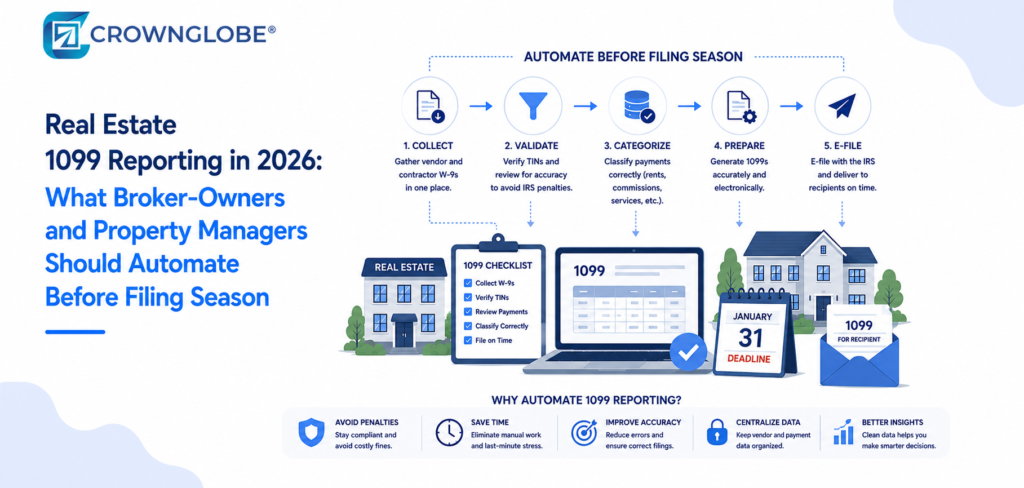
If your goal is to reduce filing season stress, focus first on automating:
- Vendor onboarding
- W-9 collection
- Vendor classification
- Payment tracking
- Document storage
- 1099 preparation workflows
These improvements usually give the compliance benefits and do not cause much disruption to operations.
The Most Common 1099 Reporting Problems Real Estate Businesses Face
Missing W-9 Documentation
Many organizations wait until filing season approaches before requesting tax documentation from vendors.
By then, several challenges can arise:
- Vendors may no longer be responsive
- Contact information may be outdated
- Required documentation may be missing
- Filing deadlines may be approaching quickly
Collecting tax information during onboarding is almost always easier than trying to obtain it months later.
Vendor Payments Spread Across Multiple Systems
Most real estate businesses rely on multiple platforms to run their operations.
These often include:
- Accounting software
- Property management software
- Bank payment platforms
- Credit card systems
- Payroll applications
When vendor data is scattered across multiple systems, identifying reportable payments becomes far more difficult.
Strong property accounting procedures help centralize information and improve reporting accuracy for real estate transactions by ensuring vendor payments and property-related costs are recorded correctly throughout the year, for property accounting procedures.
Vendor Classification Issues
Vendor classification mistakes often go unnoticed until filing season arrives.
Many businesses discover problems only when preparing information returns or reviewing year-end reports.
Organizations that maintain disciplined bookkeeping for real estate operations are usually able to identify and correct these issues much earlier.
Why Automation Matters More Than Software Alone
Technology can certainly improve efficiency, but software by itself is not a complete solution.
Many companies invest in real estate accounting software expecting automation to eliminate reporting challenges.
Unfortunately, technology cannot fix weak processes.
Even the best accounting software for real estate investors still depends on:
- Proper implementation
- Accurate vendor setup
- Consistent transaction coding
- Ongoing review procedures
- Regular reconciliations
The strongest results come when technology is paired with sound accounting controls and reliable bookkeeping practices.
Snippet Block: Signs Your Current Process Needs Improvement
Your current 1099 process may need attention if:
- Vendor information is incomplete
- W-9 forms are collected manually
- Contractor payments require spreadsheet tracking
- Vendor records exist in multiple systems
- Filing deadlines create recurring stress
- Reporting errors happen year after year
How Brokerages Can Automate 1099 Reporting
Growing brokerages often process hundreds of contractor payments and commission-related transactions every year.
Automation can help simplify these responsibilities significantly.
Vendor Onboarding Workflows
Every contractor should complete the necessary documentation before receiving payment.
An automated onboarding process can help collect:
- W-9 forms
- Contact information
- Tax identification details
- Vendor classifications
When documentation is gathered upfront, year-end reporting becomes much easier.
Payment Tracking Automation
Automated payment tracking helps ensure reportable transactions are captured accurately throughout the year.
This reduces the need for time-consuming manual reviews during filing season.
Financial Reporting Dashboards
Brokerages that invest in finance automation often gain better visibility into:
- Contractor payments
- Missing documentation
- Vendor reporting status
- Filing season readiness
Many growing firms combine finance automation with remote accounting support to improve consistency, visibility, and compliance oversight.
What Property Managers Should Automate Before Filing Season
Property management companies face unique reporting challenges because they regularly work with:
- Maintenance contractors
- Repair vendors
- Cleaning services
- Landscaping providers
- Inspection companies
Without standardized systems, tracking vendor activity across multiple properties can quickly become difficult.
Strong property management bookkeeping procedures help ensure:
- Vendor information remains current
- Payments are categorized correctly
- Documentation is easy to retrieve
- Reporting obligations are identified early
Many businesses managing properties benefit from professional real estate bookkeeping support that keeps real estate bookkeeping records organized year-round to improve real estate bookkeeping reporting consistency.
The Role of IRIS and Future Reporting Changes
The IRS continues to modernize information return filing through the Information Returns Intake System, commonly known as IRIS.
Businesses that regularly file information returns need to understand the filing requirements because they are changing all the time and it is becoming very important, for businesses.
While filing methods and reporting systems keep changing one principle stays the same.
The cleaner and more organized your records are, throughout the year the easier it is to do the tax compliance when the tax filing deadlines arrive for your tax records.
This is one reason many businesses invest in year-end finalization and annual checkup services well before reporting season begins.
A Practical 1099 Readiness Checklist for Real Estate Businesses
Before filing season arrives, every brokerage and property management company should review the following areas.
Vendor Records Review
- W-9 forms collected
- Vendor contact information updated
- Tax identification information verified
- Vendor classifications reviewed
Payment Review
- Contractor payments tracked
- Vendor reports generated
- Missing transactions investigated
- Payment systems reconciled
Accounting Review
- Books updated monthly
- Financial statements reviewed
- Vendor expenses categorized correctly
- Reporting procedures documented
Compliance Review
- Filing deadlines identified
- Documentation organized
- Electronic filing procedures reviewed
- Internal responsibilities assigned
Businesses that complete these steps consistently throughout the year usually have a smoother filing season for their businesses.
Why Good Bookkeeping Makes 1099 Compliance Easier
Many business owners think of bookkeeping and tax compliance as separate functions.
In reality, they work hand in hand.
Strong real estate bookkeeping creates the foundation for:
- Accurate vendor reporting
- Better financial statements
- Improved audit readiness
- Faster tax preparation
- Lower compliance risk
Whether your business focuses on brokerage operations, rental property accounting, accounting for rental properties, or real estate investment accounting, clean and accurate books make every reporting requirement easier to manage. They also provide a stronger foundation for accounting for rental business operations, tax planning, and year-end compliance reviews.
Conclusion
1099 reporting should never become a January emergency.
The brokerages and property management companies that do well during filing season are usually the ones that prepare for it all year.
Business owners can reduce compliance risk. Improve reporting accuracy by implementing stronger processes and maintaining organized records, for the business.
Businesses that invest in automation and organized bookkeeping will spend time fixing problems and more time focusing on the growth of their businesses.
Strong real estate accounting practices, reliable reporting systems, and well-maintained vendor records create a smoother filing process today while building a stronger financial foundation for the future.
FAQ Section
What information should real estate businesses collect before issuing vendor payments?
Businesses should generally collect vendor information, tax documentation, and classification details before making payments. Specific requirements should always be reviewed with qualified tax professionals.
Can accounting software automatically prepare 1099 reports?
Many real estate accounting software platforms include reporting functionality. However, accurate results still depend on proper setup, vendor classification, and transaction coding.
Why is W-9 collection important?
W-9 forms provide essential tax information needed for reporting purposes. Collecting them during onboarding helps avoid delays and compliance issues later.
How can property managers reduce 1099 reporting errors?
Automating vendor onboarding, payment tracking, document management, and reporting workflows can significantly improve accuracy and reduce manual effort.
Does bookkeeping affect 1099 compliance?
Yes. Accurate bookkeeping supports vendor reporting, payment tracking, financial statement accuracy, and overall tax compliance throughout the year.