You’re growing across states. Sales tax shouldn’t slow you down.
Running a business in multiple states means more customers and more complicated sales tax rules. We help you build a compliant, scalable sales tax system: nexus determination, -state registrations and accurate rate setup are important for exemption certificate workflows and ongoing filing, in all required states.
Why Multi-State Sales Tax Compliance Matters
Managing sales tax across multiple states can become complex as each state has different nexus rules, tax rates, filing schedules, and reporting requirements. Businesses selling online or operating in several states often struggle with registrations, exemption certificates, changing thresholds, and audit exposure risks. Crownglobe helps businesses build a structured multi-state sales tax process with nexus reviews, filing workflows, accurate tax configurations, compliance tracking, and automation tools that keep reporting organized and deadlines under control.
- If you sell into multiple states, you may run into: - Nexus confusion (economic vs. physical): selling online can create obligations even without a physical office. When you sell things to people in states you can get really confused about sales tax. If you have a store you might have to deal with sales tax even if you do not have a physical office in that state. This is called Nexus. It can be really hard to understand especially when you are trying to figure out the difference between economic and physical presence in a state. Sales tax can be a problem, for people who sell things online to people in many states.
- The rules and thresholds are different, in each state. They can change, which is really easy to miss.
- Crownglobe builds your sales tax system like an operating process: - We perform a nexus and exposure review, then map required registration states.
- We design your collection and rate configuration to reduce errors.
- We implement a filing calendar + workflow so deadlines don’t slip.
- We keep all our documents in order, like certificates and reports so we are always ready, for an audit of our documentation system.
- We add automation, like Stripe Tax, Avalara and TaxJar where it helps. We never rely on these tools alone without having some controls in place.
- We integrate tools like Stripe Tax, Avalara, and TaxJar with structured controls to improve accuracy and maintain reliable tax compliance processes.

Sales Tax & Nexus Services
Multi Tax Filling – $50 per State/Month
We help businesses manage multi-state sales tax compliance with accurate registrations, nexus tracking, filing workflows, and organized reporting systems. Our team identifies both physical nexus, such as offices, employees, inventory, and on-site services, as well as economic nexus based on state sales thresholds and transaction activity.
Our process is designed to reduce compliance risks, improve tax accuracy, and support smooth expansion into new states. From sales tax registrations and permit setup to tax rate configuration and taxability mapping, we help create a structured and reliable compliance system.
We also manage monthly and quarterly sales tax filings, exemption certificate tracking, audit preparation, and notice response coordination with accuracy and consistency. With organized workflows and ongoing compliance support, we help businesses stay prepared, compliant, and financially organized across multiple states.

Multi‑State Sales Tax Registration
We help with:
- State sales tax permit registration (and related accounts)
- Setup checklists for each state portal
- First‑return readiness
Deliverable: “Registration Tracker + Portal Access Pack.”

Rate Configuration & Tax Calculation Controls
We implement controls so you don’t under/over collect:
- Correct tax settings in your platform/payment stack
- Product/service taxability mapping (as applicable)
- Shipping/handling tax rules (varies by state)
- Local tax handling (state/local layers)
Deliverable: “Rate + Taxability Rules Sheet” (tool‑agnostic).

Returns Preparation & Multi‑State Filing Management
We manage:
- Monthly/quarterly returns, per-state cadence
- Pre‑file reconciliation: collected vs. expected vs. remitted
- Payment confirmations and filings archive
Deliverable: “Filing Calendar + Returns Archive.”

Exemption Certificate Management
We build a scalable process for:
- Collecting certificates
- Validity checks
- Secure storage + retrieval by customer/state
Deliverable: “Certificate SOP + Repository Structure.”

Notice Management & Audit Support Coordination
When you get letters, notices, or queries:
- We organize responses, documentation, and reconciliation support
- We help you understand what’s being asked and gather the proof
(Not legal advice; escalation to a tax attorney when needed.)
Benefits
We help businesses simplify multi-state sales tax compliance with organized workflows, accurate reporting, and scalable filing systems designed to reduce risk and improve operational control.

Clarity
Understand exactly where your business must register, collect, and file sales tax without confusion around nexus rules or state requirements.

Control
Maintain a structured filing process with reconciliation routines and organized workflows that reduce reporting errors and missed deadlines.

Compliance Safety
Lower the risk of penalties, interest, and audit exposure with accurate filings, tracked deadlines, and properly maintained documentation.

Scalability
Build a sales tax process that grows with your business as you expand into new states, warehouses, or remote work locations.

Deal Readiness
Maintain clean and organized sales tax records that support fundraising, bank lending, acquisitions, and future business growth opportunities.
Multi-State Sales Tax Process Timeline
Our structured sales tax workflow helps businesses stay compliant across multiple states with organized registrations, filing systems, and ongoing compliance monitoring. From nexus analysis to reporting and quarterly reviews, we build a scalable process that keeps your sales tax operations accurate and manageable.
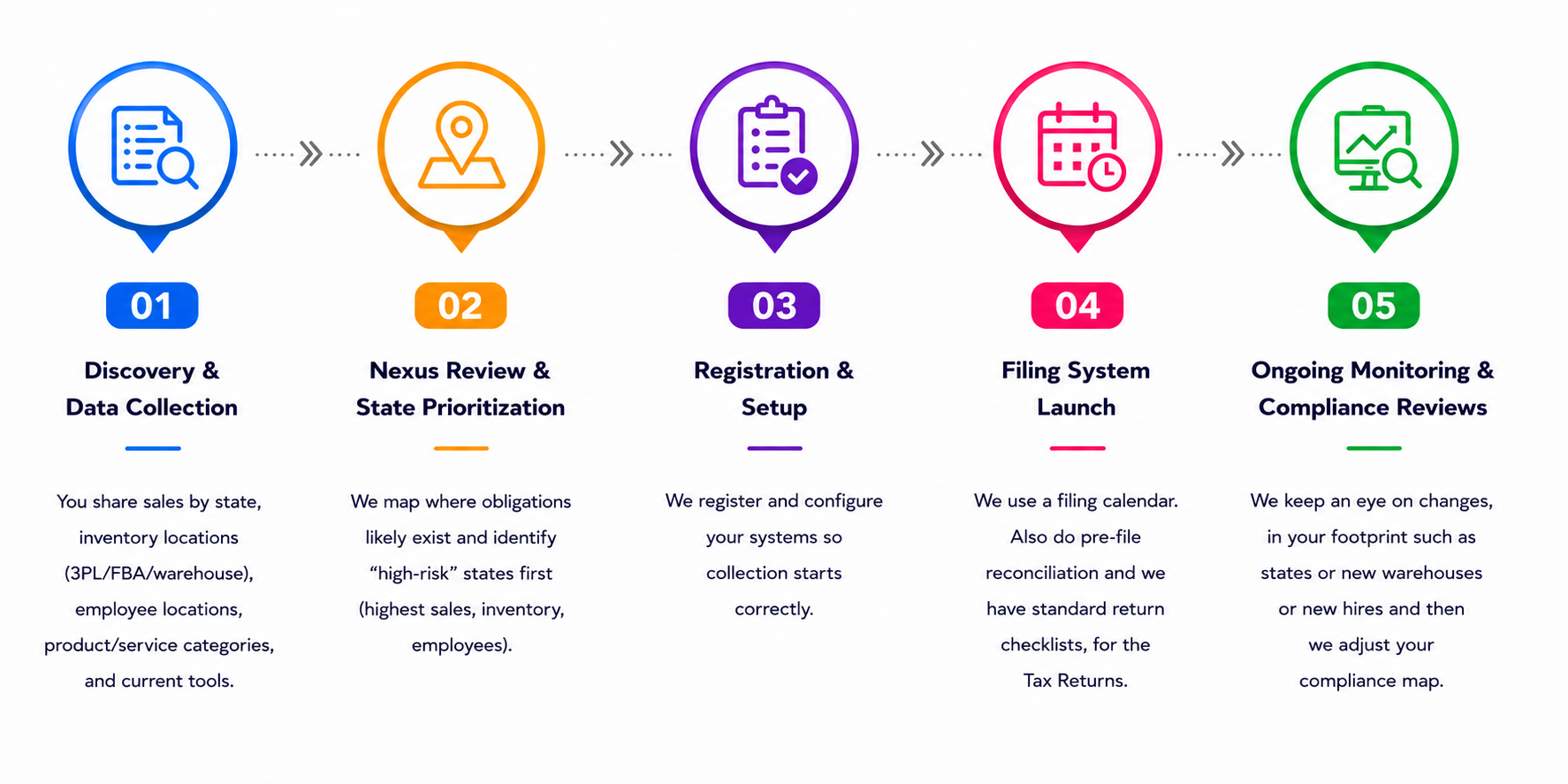
Discovery & Data Collection
You share sales by state, inventory locations (3PL/FBA/warehouse), employee locations, product/service categories, and current tools.
Nexus Review & State Prioritization
We map where obligations likely exist and identify “high-risk” states first (highest sales, inventory, employees).
Registration & Setup
We register and configure your systems so collection starts correctly.
Filing System Launch
We use a filing calendar. Also do pre-file reconciliation and we have standard return checklists, for the Tax Returns.
Ongoing Monitoring & Compliance Reviews
We keep an eye on changes, in your footprint such as states or new warehouses or new hires and then we adjust your compliance map.
Sales Tax
Sales tax rules change from state to state, and the point at which you owe is rarely the same twice. Our Sales Tax guides set out the current state and combined rates, economic nexus thresholds, which goods and services are taxable or exempt, and the registration and filing steps for all 50 states, one guide at a time.
Case Study

Client
E‑commerce brand selling nationwide
Challenge
Rapid growth triggered economic nexus in multiple states; filings were inconsistent; no certificate system for wholesale customers.
Solution
Crownglobe performed nexus mapping, registered in required states, configured tax calculation controls, implemented a filing calendar, and built a certificate workflow.
Result
On‑time filing system established, reduced compliance risk, improved audit readiness, and eliminated “surprise” sales tax exposure during funding diligence.
FAQs
Sales tax nexus is the connection that obligates a business to collect and remit sales tax in a state. Nexus can be physical (e.g. having inventory, employees, or an office in the state) or economic (e.g. exceeding sales thresholds). After South Dakota v. Wayfair (2018), many states impose sales tax obligations based on economic activity alone. If your business triggers nexus in a state, you must register for a sales tax permit there and comply with its tax rules.
Physical nexus arises from tangible presence in a state. For example, having employees, inventory, or property in the state typically creates nexus. Even out-of-state companies can establish physical nexus by storing goods in a fulfillment center (like Amazon FBA) or by employees working there. Once physical nexus exists, the business must collect and remit that state’s sales tax on taxable sales to customers in that state.
Economic nexus is based on sales volume. Many states follow the Wayfair model: grossing over $100,000 in sales or 200 transactions in the state within a period. However, each state can set its own rules – some use only taxable sales amounts, some include resale sales, and some use a rolling 12-month window. When your sales exceed a state’s economic threshold, you are required to register for that state’s sales tax and begin collecting tax on applicable sales.
As soon as you determine that nexus is met (physically or economically), you must register for a sales tax permit in that state before you collect tax. Registration usually involves applying for a Certificate of Authority or Sales Tax Permit via the state’s tax portal. For example, in Massachusetts you use MassTaxConnect to get a Sales Tax Certificate of Authority. After registration, you can legally collect sales tax and file returns. (Until registration is complete, you may need to accrue tax and file a return once approved.)
Once registered, you must charge the correct tax rate on each sale. This means configuring your e-commerce or invoicing system with the state’s sales tax rates and rules. Rates vary by jurisdiction and product type. It’s best practice to use a reliable tax calculation system (e.g. Avalara, TaxJar, or Stripe Tax) that keeps rates up-to-date. You should also map which products or services are taxable in each state and handle local levies (counties, cities) appropriately. Periodically reconciling collected tax against what should have been collected helps catch errors before filing.
Filing frequency (monthly/quarterly) depends on each state’s rules and your sales volume. Some states require monthly returns if you collect above certain amounts; others allow quarterly or annual filings. Each state and locality has its own due dates and payment methods. For example, you might file monthly in one state and quarterly in another. Keeping a consolidated filing calendar is crucial. Our service maintains a Filing Calendar and archives each return to ensure on-time compliance in every jurisdiction.
Maintain detailed records of all sales, tax collected, and remitted. Keep copies of sales tax returns, payment confirmations, and exemption (resale) certificates. You should track sales by jurisdiction (state/county/city) and maintain backup invoices. In case of audit, you’ll need an audit trail showing what tax was charged or why it wasn’t (i.e. valid exemption certificates). Organized records help demonstrate compliance and simplify any future reviews or audits.
A resale or exemption certificate allows a purchase to be made tax-free when the buyer resells the item or is otherwise exempt. For example, wholesalers purchase inventory tax-free by providing a resale certificate. Nonprofits or certain organizations may also be exempt and provide certificates. You must collect a valid certificate at the time of sale for any exempt transaction. Without it, the sale is presumed taxable.
Effective certificate management means collecting, validating, and storing certificates securely. You should obtain a certificate for each exempt customer and document their exemption status. Certificates expire or change, so track expiration dates and renew as needed. Automation tools can help manage certificates, but the key is having a process: for example, a central repository (like a secure cloud folder) and periodic certificate audits. Our service sets up such a process so certificates are current and easily retrievable for each state.
If a state audits you, they will examine your sales to ensure tax was correctly collected or exempted. Auditors often use sampling rather than checking every transaction. This means if a sample shows missing tax (e.g. a missing certificate), they may apply that finding more broadly. Therefore, you need complete documentation for exempt sales. Having exemption certificates on file for audited transactions can prevent a tax liability during an audit. Our audit support means we help gather documents, respond to notices, and explain any discrepancies with the tax agency.
Yes. Most states now have marketplace facilitator laws. These laws make platforms like Amazon or eBay responsible for collecting and remitting sales tax on behalf of third-party sellers. If you sell through such marketplaces, you may not need to collect tax on those sales yourself (the marketplace will do it). However, you should confirm which marketplace sales are covered and ensure you don’t inadvertently collect tax twice. (Meanwhile, sales you make directly on your own site still require normal nexus and collection logic.)
State and local sales tax laws change frequently (new rates, thresholds, products). To stay compliant, you must monitor changes in every state where you have nexus. Using a sales tax automation tool (TaxJar, Avalara) can help by automatically updating rates and flags for nexus. Alternatively, a managed service will handle this: we continuously review your footprint (sales, inventory, employees) and track legislative changes so your compliance map is always current.
Common errors include: failing to register after nexus is hit, charging incorrect rates (often forgetting local taxes), filing late or in the wrong frequency, and not obtaining exemption certificates for tax-free sales. For example, many sellers overlook economic nexus thresholds and start selling tax-free until faced with back taxes. Another pitfall is not tracking remote employees or inventory locations, which can unexpectedly create nexus. Our process is designed to catch these issues: we perform a thorough Nexus Assessment, ensure correct rate configuration, and implement controls (like certificate collection) to prevent such mistakes.
Automation can greatly simplify compliance. Tax engines (Avalara, TaxJar, Sovos, etc.) can calculate taxes in real-time and manage filing workflows. For instance, TaxJar’s blog emphasizes that automation “helps you understand and determine if you have exceeded any nexus thresholds”. However, tools must be configured correctly and paired with human oversight. We often integrate automation for tasks like tax calculation and filing reminders, while our team ensures the system’s data and rules are accurate. This hybrid approach scales with your business growth.
A managed sales tax service brings expertise and consistency. Multistate compliance is complex; a mistake can cost penalties and interest. With a service like Crownglobe’s, you get a repeatable process: we map your nexus exposure, register in required states, set up a filing calendar, and maintain all documentation (returns, certificates) in one place. This clarity and control reduce audit risk and free you to focus on growth, knowing that your sales tax obligations (nexus determination, filings, exemptions) are handled professionally.
Accelerate Your Business Growth
Discover our core solutions designed to streamline your financial operations and branding.
Schedule a Free Consultation
Multi‑state growth is a great problem to have - until sales tax becomes the bottleneck. Crownglobe’s Multistate Sales Tax Filling service gives you a repeatable system for nexus tracking, registration, tax calculation controls, filing execution, and documentation so you stay compliant and scale confidently. Schedule a Free Consultation and get a clear action plan for your business.
Book a Consultation