Our Financial Statement Preparation service helps make your numbers easy to trust and understand.
Clear statements. Confident decisions.
Financial statements are really important for business leaders and lenders because they need them to make smart decisions, about money and funding.
Why Financial Statements Matter
Financial statements give business owners a clear view of company performance, cash flow, expenses, and overall financial health. They are essential for making informed business decisions, securing financing, attracting investors, and planning future growth with confidence. Crownglobe prepares accurate and organized financial statements using your accounting records and supporting documents while helping you choose the right reporting method based on your business and tax requirements.
- Financial statements help you understand where your money came from, where it went, and where it is now.
- They are commonly used by leadership and by external parties such as lenders and investors to evaluate performance and financial position.
- If you’re preparing for financing, planning growth, or simply trying to run the business with fewer surprises, financial statements are the baseline.
- Financial statements provide a clear view of a business’s income, expenses, and overall financial position to support better decision-making.
- They are used by business owners, lenders, and investors to evaluate performance, plan growth, and assess financial stability.

- Crownglobe prepares clean, consistent financial statements from your accounting records and supporting documentation.
- We also help you choose the right reporting basis (cash vs accrual) depending on your needs; for tax accounting, the IRS explains cash method generally reports income when received, while accrual generally reports income when earned.
- If you’re starting from messy data, we can pair this service with cleanup and monthly close support: Bookkeeping Services
- We prepare accurate financial statements from your accounting records, help determine the appropriate reporting basis, and ensure your financial data is clean, structured, and ready for reporting or compliance needs.

Financial Statement Preparation Services
We prepare organized and accurate financial statements that help business owners, lenders, investors, and tax professionals clearly understand company performance. Our reporting process improves financial visibility and supports informed business decisions with confidence.
Our team prepares balance sheets, profit and loss statements, cash flow reports, and equity reporting with accuracy and consistency. We also manage accounts receivable and payable schedules, monthly reporting, and year-end financial statement preparation.
With lender-ready and investor-ready reporting packages, we help businesses stay organized for financing, tax filing, and compliance needs. Our goal is to deliver reliable financial reporting systems built for clarity, accuracy, and long-term business growth.
We prepare accurate and organized financial statements, including balance sheets, profit and loss statements, and cash flow reports, to support clear financial visibility and informed business decisions.

Balance Sheet Preparation
A balance sheet is a snapshot of your business’s assets, liabilities, and equity at a point in time, and it’s widely treated as foundational for managing business finances.

Profit & Loss Statement Preparation
Your income statement is, like a report that tells you how money your business made and how much it spent over a certain period of time.

Cash Flow Statement Preparation
Cash flow statements are really important because they show how cash moves through activities, like operating, investing and financing activities of a company.

Owners’ / Shareholders’ Equity Statement Preparation
Many businesses also include a statement of equity, showing changes in owners’/shareholders’ interests over time.

Notes & Management Schedules
We give you information like lists of what people owe us and what we owe them so you can use our statements, for things like getting a loan or doing your taxes.

Lender & Investor Reporting Packs
If you’re applying for financing, we assemble a lender-ready package aligned to what lenders typically expect when evaluating business stability and performance.
Benefits

The 4 core statements
A widely recognized set of core statements includes income statement, balance sheet, cash flow statement, and statement of shareholders’ equity.

Balance sheet = foundation
The SBA describes the balance sheet as the foundation of managing your finances, helping track assets, liabilities, equity, and supporting planning.

Cash flow classification matters
Under the statement of cash flows guidance (ASC 230), cash flows are classified as operating, investing, or financing; classification decisions can be complex and attract scrutiny so your statement should be done carefully.
Process Timeline
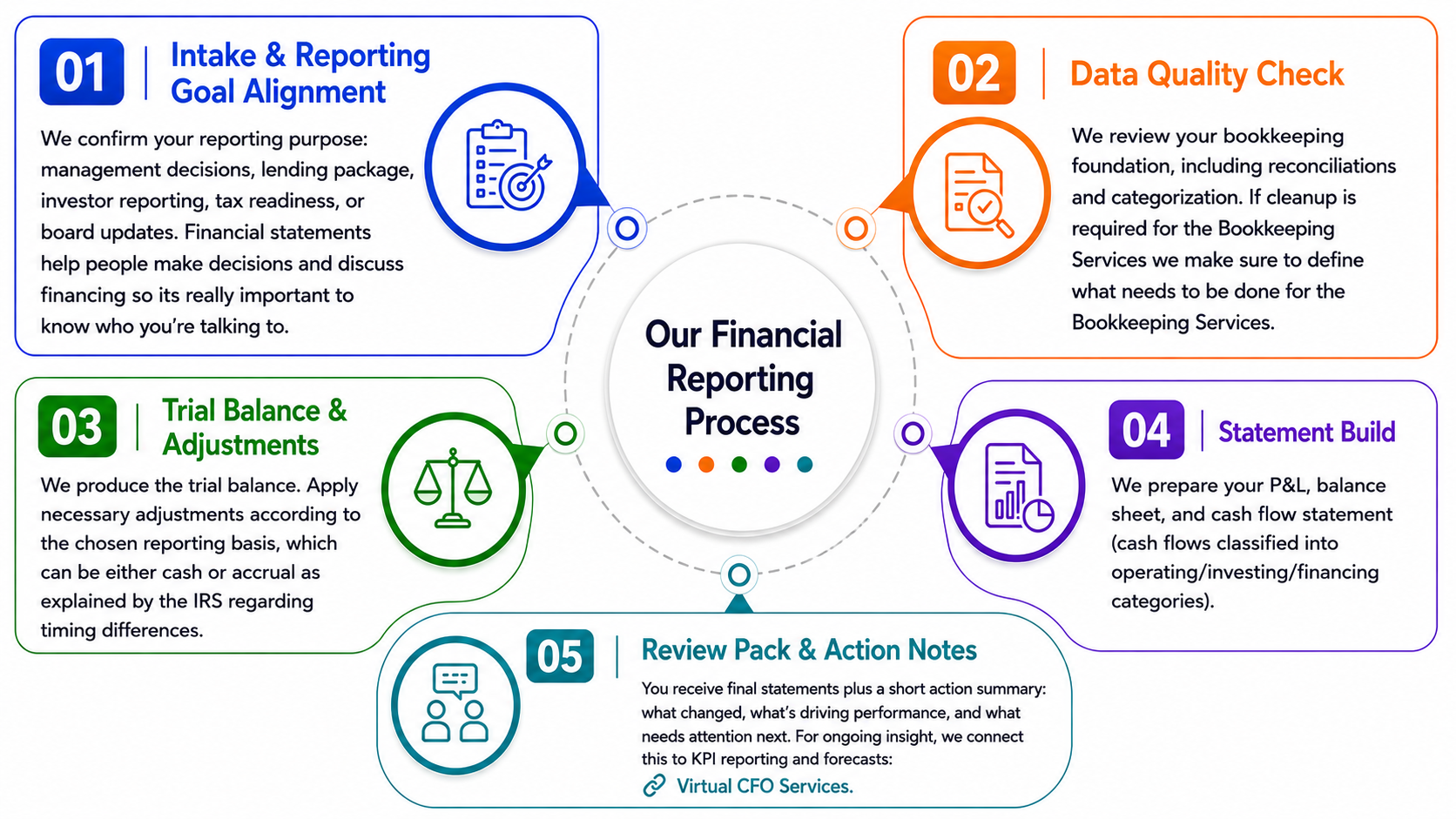
Intake & Reporting Goal Alignment
We confirm your reporting purpose: management decisions, lending package, investor reporting, tax readiness, or board updates.Financial statements help people make decisions and discuss financing so its really important to know who you’re talking to.
Data Quality Check
We review your bookkeeping foundation, including reconciliations and categorization.If cleanup is required for the Bookkeeping Services we make sure to define what needs to be done for the Bookkeeping Services.
Trial Balance & Adjustments
We produce the trial balance. Apply necessary adjustments according to the chosen reporting basis, which can be either cash or accrual as explained by the IRS regarding timing differences.
Statement Build
We prepare your P&L, balance sheet, and cash flow statement (cash flows classified into operating/investing/financing categories).
Review Pack & Action Notes
You receive final statements plus a short action summary: what changed, what’s driving performance, and what needs attention next. For ongoing insight, we connect this to KPI reporting and forecasts:
Virtual CFO Services
Case Study

Replacing Manual Processes
A rapidly growing SaaS company was spending significant time on manual financial processes, limiting efficiency and scalability. Crownglobe implemented advanced Finance Automation solutions to streamline key accounting workflows. Our team automated invoicing, bank reconciliations, and financial reporting, reducing repetitive administrative tasks. The new systems improved accuracy, enhanced visibility into financial performance, and minimized the risk of human error. By integrating automated processes, the company was able to manage increasing transaction volumes with ease. As a result, finance operations became faster, more efficient, and fully equipped to support continued business growth.
FAQs
Financial statements are standardized reports (balance sheet, income statement, cash flow statement, equity statement) that summarize your business’s financial position and performance. They are essential because they provide insight into assets, liabilities, revenue, and expenses, enabling informed decisions and demonstrating credibility to lenders or investors.
It depends on your needs. Many businesses prepare them monthly for internal management and quarterly or annually for external use. If seeking financing, lenders often require monthly or quarterly statements to assess ongoing performance. We can deliver statements on whatever schedule aligns with your business goals.
Virtual CFO Services
We use your general ledger, trial balance, bank statements, and source documents (like invoices and receipts). If books are incomplete, we may reconcile accounts or make adjusting entries (for accruals, depreciation, etc.) to ensure the trial balance is accurate before building statements.
Under the cash basis, revenue is recorded when cash is received, and expenses when cash is paid. Accrual basis records revenue when earned and expenses when incurred, regardless of cash flow. The accrual method is generally required for larger businesses and provides a more complete picture. We help you choose the right basis for your needs, and apply consistent rules for whichever you select.
The core set includes: (1) Income Statement (Profit & Loss), showing revenue and expenses over a period; (2) Balance Sheet, showing assets, liabilities, and equity at a point in time; (3) Cash Flow Statement, detailing cash from operating, investing, and financing activities; and (4) Statement of Equity, showing changes in owner or shareholder equity. These give a full view of the business finances.
Consistent financial statements ensure that income and expenses are well-documented for tax returns. For example, depreciation schedules and expense classifications are already prepared, which streamlines tax filings. Clean statements reduce surprises at tax time and may reveal additional deductible expenses.
Yes. We build statements directly from your bookkeeping records. If books need cleanup (e.g. missing entries or incorrect categorization), we address those first. Many clients pair this service with bookkeeping cleanup to ensure the foundation is solid before statements are prepared.
Supporting schedules (like A/R aging, A/P aging, fixed asset schedules, loan amortizations) provide detail behind the numbers on the main statements. Lenders and auditors often expect these schedules for verification. We include them to give context and make your statements more useful for decision-making.
Lenders review financial statements to evaluate your ability to repay a loan. They look at trends in revenue, profitability, and cash flow. Providing clear, well-prepared statements with notes builds credibility. We often prepare “lender-ready” packs that address common lender concerns, such as showing consistent cash flows and clear debt schedules.
Virtual CFO Services
Generally, it involves: (1) Verifying data quality (reconciled accounts, categorized expenses), (2) Generating the trial balance, (3) Making adjustments (accruals, deferrals, depreciation), (4) Building the statements (P&L, balance sheet, cash flow, etc.), and (5) Reviewing with you for insights. We follow a structured review workflow to ensure accuracy at each step.
In the Cash Flow Statement (per ASC 230), cash flows are grouped as Operating, Investing, or Financing activities. For example, cash received from customers is operating, buying equipment is investing, and taking a loan is financing. Correct classification is important; we meticulously assign each item to the right category so your cash flow statement meets accounting standards and supports decision-making.
Yes. While we prepare the standard formats, we can also tailor reports to your needs. For instance, restaurant clients might want separate food and beverage lines, or a service firm might want segmented revenue streams. We work with you to include additional schedules or metrics (like EBITDA, key ratios) that align with your business model.
With up-to-date statements, you can spot trends and anomalies early. For example, if expenses spiked unexpectedly, you’ll see it in the next month’s P&L. The balance sheet helps manage cash and debt levels. By having current and accurate statements, you make strategic choices based on real data instead of guesswork.
Virtual CFO Services
Legally, businesses must maintain accurate records, but not all small firms regularly prepare formal statements. However, if you seek loans, investors, or just want better financial control, having professional statements is highly recommended. They provide transparency to stakeholders and ensure compliance with accounting regulations.
First, gather your bookkeeping records and decide on reporting frequency. Then schedule a consultation to define goals (management reporting, lender packet, etc.). We’ll review your data, advise on any needed clean-up, and set up a schedule for statement delivery. Once underway, you’ll receive reports and actionable insights on time.
Schedule a Consultation
Accelerate Your Business Growth
Discover our core solutions designed to streamline your financial operations and branding.
Schedule a Free Consultation
If your financial statements feel confusing, inconsistent, or late, you’re making decisions with incomplete information. Financial statements help show where your business’s money came from, where it went, and where it is now so you can act with confidence.
Book a Consultation